Your Kids Will Test You — And That’s a Good Thing

By: A Mindful Dad’s Life

The first time my son really tested me, it caught me off guard. We were mid-conversation about something small (cleaning up his Legos, I think) and out of nowhere, he looked me right in the eye and said, “I don’t care.”

I knew in that moment he didn’t want to pick up the Legos, that much was clear. But it wasn’t really about the Legos. It was about me.

And for a split second, I felt that familiar adult urge: shut it down, take control, remind him who’s in charge.

But I caught myself.


Because this wasn’t defiance for the sake of defiance. This was a question in disguise:
“Are you still my safe place when I’m not easy to love?”

The Hidden Purpose of These “Tests”

Kids can’t always explain their feelings, so they push them outward. Sometimes that looks like talking back, breaking a rule, or going silent when you try to talk.

Underneath it all, they’re looking for answers to questions they don’t have the words for yet:

If I mess up, will you still show up for me?

Do you hear me when I’m struggling, or only when I’m well-behaved?

Can I trust you with the real me, even if the real me is messy right now?

The Reflex We All Have: And Why It Doesn’t Work

As parents, it’s easy to react from habit:

“Don’t talk to me like that.”

“Go to your room.”

“Because I said so.”

Those responses might stop the behavior for the moment, but they don’t answer the deeper question. In fact, they can teach the opposite: I’m only loved when I’m easy.

Over time, that pushes kids to hide their feelings, avoid honesty, and pull away when life gets hard. It also limits their ability to become a safe place for others. This can be especially challenging for boys, who may grow into men without learning emotional security or how to relate to others with empathy.

Meeting the Test Without Losing Yourself

This isn’t about letting your kid run wild. It’s about staying steady enough to guide them through the storm instead of joining it.

  1. Slow your reaction, here is where I usually take a breath. Pause before you speak. Remind yourself that connection comes before correction.
  • Get curious. Ask, “What’s really going on here?” Sometimes the anger is about something that happened hours ago, or about something unrelated to you.
  • Hold the boundary, keep the bridge. It’s okay to say, “I love you, but it’s not okay to yell at me.” Boundaries create safety when they’re delivered with respect.
  • Circle back. The real conversation often happens later, when the heat’s gone. Use that time to reconnect and help them name what they were feeling.

Why It Matters More Than You Think

Every time you pass one of these tests, you’re teaching your child:

  1. They can bring their whole self to you.
  • You can handle their big emotions without shutting them down.
  • Love in this family doesn’t vanish when things get hard.

That’s the kind of foundation they’ll carry into every friendship, relationship, and challenge for the rest of their life.

In the end, the test isn’t about you “passing” or “failing.” It’s about showing your child that when life gets messy, and it will, you’ll still be there for them.


Your Turn: Think about the last time your child “tested” you. How did you respond? What could you do differently next time to show them you’re a safe place, even when emotions run high? Share your thoughts with other parents, or start the conversation at your next family meal. The more we talk about this, the more we grow together.

Raised by Wolves: The Word I Swore I’d Never Say

By: The Mindful Dad’s Life

My son and I have a new favorite food, burritos from Whole Foods. We had one last weekend after a two-hour rock-climbing session, and it was hands down the best thing either of us had eaten in a long time. It’s become a bit of a ritual now: climb hard, burrito recharge.

Yesterday, after a 6-hour track meet, we stopped in again for a late lunch. We were both pretty hungry. My son ordered first. The woman behind the counter was Russian, I think. She was very polite, patient, and attentive. She listened carefully as he confidently asked for a half-pork, half-steak burrito with rice, sour cream, and hot sauce.

He had watched the burrito-making process closely the last time and thought he knew the routine. So when she placed the wrap in the steamer and turned away to grab something, he got a little impatient. Standing on a nearby display shelf, he said loudly, “Where’s the wrap, stupid?”

Without thinking, I grabbed him firmly by the shoulders and pulled him down.

“That is incredibly disrespectful and rude,” I said, my voice low but sharp. “You do not call someone stupid. You don’t know her, and she’s the one working to make your food. She would probably rather be someplace else, and she’s doing her best. You treat her with kindness and respect.”

He nodded silently, eyes downcast. I let go of his shoulders, and he walked a few steps away. A minute later, he came back and tried to play with me, like nothing had happened.

But something had happened: for both of us.

As we stood there waiting for our food, I found myself replaying the moment again and again. The moment cracked open something old in me, something buried deep but not forgotten. Was that the best way to handle it?

Because the truth is, I flinched when I heard that word. Stupid. That word lived in my house growing up. It lived in my mother’s voice. She called me stupid almost every day until I was 16, when I finally stood up and said, “I’m not stupid. I’m actually really smart.” Her response was to come at me with a broom handle. That day, for the first time, I was strong enough to stop her and walk away, unharmed and strangely proud. Proud that I had finally stood up for myself.

That word *stupid* carries a weight in my life. It was never just a word. It was a label, a weapon. So when I heard it from my son’s mouth, even casually, it hit like a wave. My reaction wasn’t just to his moment, it was to mine, still echoing years later.

And yet, my son is not me. He’s a child, not a threat. He was hungry, tired, and trying to be funny. He was pushing the boundary, not breaking it. And I, the man trying so hard to do this right, reacted from a place of pain instead of presence.

In no way do I ever condone the beating of children as a form of discipline. I was, hopefully, the last generation of children to have been beaten by their parents. I was hit with hands, fists, belts, my own toys, cricket bats, and broom handles. It left a very deep mark on my psyche that took years to heal, years to learn to trust, to love, and to feel safe again in my own body.

So I ask myself now: was it okay to grab him like that?

In that moment, it felt necessary. I wasn’t rough. I didn’t yell. But it was immediate and stern. I wanted to stop the behavior before it grew roots. And for boys, who often learn through movement and energy, sometimes a physical redirection can be helpful, but only when it’s calm, non-threatening, and followed by reflection. (That’s the part I didn’t do.)

Still, I know I could have done better. A touch on the shoulder. A quiet crouch to his level. A firm, respectful tone without needing to startle him. I could have protected the moment without letting my old wounds lead the charge.

That instinct I felt—the flash of heat, the pull to act—that’s the wolf in me. The part that learned, as a boy, that no one was coming to protect me, so I had to learn to protect myself. It kept me safe. It gave me strength. But that wolf, while loyal and fierce, now needs to learn how to be gentle around my son.

My son doesn’t need to be hardened to survive. He needs to be guided to thrive.

We never spoke about it again, but I made sure to thank the woman sincerely when she handed me my burrito. Not just for the food, but to show him how I treat others.

I’m still learning.

Still healing.

Still choosing the father I want to be, every single day.

And to any parent reading this who has ever questioned themselves, I see you. You’re not alone. The journey is hard sometimes, but you’re doing the work, and that matters more than perfection ever could.

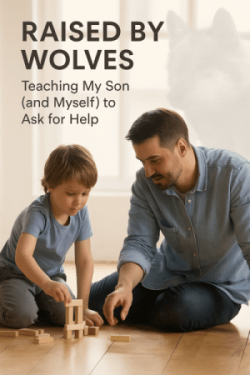
Raised by Wolves – Teaching My Son (and Myself) to Ask for Help

By The Mindful Dad Life.

This story is part 2 of a series of posts that need to be written, both for my own reflections and to help me understand what kind of dad I want to be.

I started noticing it when my son was about four or five. He’d be sitting on the floor with his blocks, or drawing something he’d never tried before, and I could see him struggling—jaw tight, shoulders stiff, refusing to look my way. He wouldn’t ask for help.

And I recognized it instantly, because I was looking at myself.

I’ve spent most of my life with that same instinct, the one that whispers, figure it out yourself, don’t bother anyone, don’t show weakness. I never taught him that, not intentionally, but kids don’t just learn what we say; they pick up who we are. In a lot of ways, we pass on survival habits without even meaning to. Raised by wolves, indeed.

It took weeks “Weeks” of patient conversations to help him get comfortable asking. I’d sit beside him and say, “What can you figure out, and what can I help you with?” or “If you need help, remember, I’m right here.” At first, he’d shake his head and try harder on his own. But slowly, he started asking. Just once in a while at first, then with a little more ease.

And every time he asked, it felt like a small victory, not just for him, but for both of us.

Because if I’m being honest, I’m still learning this myself.

The Freeze

Not long ago, a friend of mine—someone I’d just helped with his art business plan and a new logo he’d been wanting for years—looked me straight in the eye and said, “Anything you need, man, just ask.”

I froze.

My mind went completely blank. Not because I didn’t need help, but because my brain didn’t know how to process that offer. I didn’t know what to say. And that’s when it hit me: this isn’t just habit, it’s wiring.

Why Men Struggle to Ask for Help

Science backs that up. Studies have shown that men are less likely than women to seek help, not just emotionally but practically, whether it’s asking for directions, reaching out for mental health support, or delegating tasks.

Some of this comes from how boys are socialized. Research published in Psychology of Men & Masculinities found that from a young age, boys are more likely to be praised for independence and problem-solving, while girls are encouraged to seek and offer help. By the time we’re adults, those patterns are deeply ingrained.

There’s also biology at play. A 2019 review in Frontiers in Behavioral Neuroscience discussed how testosterone and stress responses interact, often making men more likely to respond to challenges with a “fight-or-flight” reaction rather than a “tend-and-befriend” one, a pattern more common in women. In other words, when something’s hard, our instinct isn’t to ask for help; it’s to grit our teeth and push harder.

That instinct kept our ancestors alive. But for fathers, for men trying to raise kids in a healthier, more connected world, it can hold us back.

The New Pack

I don’t want to raise my son to be a lone wolf. I want him to know that asking for help isn’t weakness, it’s trust. It’s connection. It’s how we build stronger families, stronger friendships, stronger lives.

The truth is, we’re not meant to do it all alone. Wolves survive in packs for a reason.

So I’m trying to rewrite this for myself as much as for him. I’m practicing saying yes when someone offers to help, even if it feels awkward. I’m practicing asking for help before things reach the breaking point. And every time my son looks up and says, “Dad, can you help me with this?” I remind myself: this is what breaking the cycle looks like.

If I can teach him that strength isn’t just doing everything alone, then maybe that’s the legacy that matters most.


For Dads Reading This

If you’re like me, you probably freeze up too. Maybe you think you need to handle everything, to be the strong one all the time. But the strongest thing you can teach your kids is that strength also looks like leaning on people you trust.

Start small. Accept help when it’s offered. Ask for help in one thing this week, even if it feels uncomfortable. Show your kids that trust is strength.

Because we weren’t meant to do this alone. And neither are they.

When Tightening the Reins Backfires: A Mindful Dad Lesson

“As soon as I tightened the reins because she had attitude, the attitude got worse.”

A fellow parent said this to me recently, and I couldn’t help but nod. I’ve been there. Honestly, I live there sometimes.

My first instinct, whenever my son pushes back, is to push harder. If he rolls his eyes or mutters something under his breath, my mind goes straight to “Oh no, we’re not doing this.” So I tighten the reins, stricter rules, sharper tone, less wiggle room. I want to make sure he knows I’m serious.

But you know what happens almost every time? His attitude gets worse. The tighter I pull, the harder he pulls back.

And when I step back and think about it, it makes perfect sense.


Why Tightening the Reins Doesn’t Work

Kids, like us, hate feeling controlled. When I tighten the rules without giving him room to breathe, I’m not just setting boundaries, I’m sending the message that I don’t trust him to manage himself. And that message, even if I don’t mean it that way, makes him want to fight back. I usually know when he feels controlled because his first response is to say, “That’s not fair.”

I get it, it’s human nature. We all want to feel heard, even when we’re wrong. And I think for dads, especially, there’s this pressure to be the enforcer. We’re supposed to keep things under control, to be the one who doesn’t bend. But I’m learning control and leadership aren’t the same thing, and my son doesn’t need a warden. He needs a guide.


What I’m Trying Instead

I’ve been experimenting with something different lately. Instead of going full drill-sergeant, I try to pause and ask myself:

  • “What’s behind this attitude? Is he frustrated, tired, embarrassed, or just trying to feel in control of something?
  • “What’s the real issue here, and what’s the outcome I want?”

Then, instead of just laying down the law, I give him choices within the boundary. For example:

  • Instead of: “You’re done with screens for the day, because you can’t talk to me like that.”
  • I’ll try: “You can take five minutes to cool off and then play, or we can turn the game off for the night. Which do you want to do?”

He doesn’t always like the options, but giving him a say changes the energy. He’s not being forced, he’s choosing. And sometimes, now that he’s getting a little older, he’ll offer up his own choice. When that happens, I stop and really listen, so he feels heard. I ask myself if his idea still fits the boundary, and if it does, I work it in so we both win.

Child psychologists say kids push back harder when they feel powerless—it’s a survival instinct. Giving choices, even small ones, tells their brain they’re safe, and they calm down faster. I’ve seen it happen in real-time; his shoulders relax, his voice softens, and we move forward instead of spiraling into a power struggle.


The Hardest Part (For Me, Anyway)

Here’s the truth: mindful parenting isn’t about being soft or letting things slide. It’s about letting go of my need to win every moment.

And that’s tough. Because when I’m tired or stressed, “winning” feels easier than connecting. Tightening the reins feels like control, but it’s usually just me reacting instead of teaching.

I’m learning that the more curious I am, the more patient I stay, the faster the attitude melts away. It’s not perfect. Sometimes I still snap, but on the days I manage to pause, we both end up calmer.


A Work in Progress

I’m not writing this as someone who has it all figured out. I still struggle. But every time I pause instead of pounce, I feel like I’m gaining something important, his trust.

And I keep reminding myself: I don’t want my son to just follow my rules. I want him to learn how to manage his own emotions, make good choices, and trust me enough to talk when things feel hard.

That doesn’t happen when I tighten the reins too hard. It happens when I guide, listen, and sometimes let go just enough for him to grow.

The real question I’m asking myself now is: Am I trying to raise an obedient kid or an emotionally intelligent one? Because the answer changes how I parent.


Your Turn

Have you ever had this happen, where tightening the reins just made things worse? What worked (or didn’t work) for you?

Parenting isn’t about perfection, it’s about showing up, time and again, and growing right alongside our kids.

Originally published on Medium

Roots and Wings: The Greatest Gift We Can Give Our Children

There’s a saying I once wrote in my journal—words that poured out of me one night after a hard parenting day: “The greatest gift I can give my son is both roots and wings.”

It wasn’t until much later I learned that Johann Wolfgang von Goethe had written something nearly identical centuries before:

“There are only two things children should get from their parents: roots and wings.”

And later, Hodding Carter echoed it:

“There are but two lasting bequests we can hope to give our children. One of these is roots, the other, wings.”

I didn’t know that when I wrote it. I had just lived it. And maybe that’s the point. Maybe we all arrive at this truth when we love deeply enough.


Roots

Roots are the foundation. They’re the morning routines, the tucked-in blankets, the bedtime stories we’ve told a hundred times—the castle we storm together, even if I run the wrong way to battle the orcs. They’re the quiet presence we offer when our kids are overwhelmed, or the moments when we choose to be with them fully, no distractions and no excuses. Those moments give them a sense of safety and allow space for big feelings they can’t yet name.

Roots are made of consistency and quiet courage. They are the traditions we build, the values we live, and the love we offer even when our kids push us away. They tell our sons:

“You belong somewhere.”
“You are grounded in something strong.”

For me, roots mean teaching my son how to calm down, how to brush his teeth, how to be kind even when he’s frustrated. It means showing up when it’s hard. It means listening, even when I’d rather walk away.
It means creating a safe place to return to, even after he’s yelled, melted down, or lost control.


Wings

Wings are the courage to let go. They’re the freedom we allow our sons to discover who they are, without shaping them into who we hoped they’d become.

Wings are in every “You’ve got this.”
Every “Go try.”
Every moment when we step back and let them rise or fall on their own.

Giving my son wings means not rescuing him from every hard moment. It means trusting that he’ll grow through the discomfort. That he doesn’t need me to be perfect, he needs me to believe in him.

Wings whisper:

“I trust you.”
“You are allowed to become.”

“You can Trust Yourself.”


The Balance

This is the hard part.
Too many roots, and we raise a child afraid to move.
Too many wings, and they might never know how to land.

But when we give both, real roots and strong wings, we raise boys who are grounded and free. Boys who become men with a deep sense of self—rooted in love, truth, and purpose—and a brave heart ready to face the world with kindness, curiosity, and strength.


For my son

If I can give you anything, my son, it will be this:
A sense that you are loved and safe, even when the world is not.
And the freedom to discover your voice, your values, and your wild, wonderful path.

These are your roots. These are your wings.
And I will be here, on the ground, cheering as you rise.