How I’m Learning to Let Go of What I Can’t Control — One Morning at a Time

What a glass of water, an iPad, and one quiet breath taught me about fatherhood and control.

by A Mindful Dad’s Life

This is Part 1 of a 4-part series on building a Stoic morning routine with my son. Each post explores one of the core Stoic virtues — starting with Wisdom.

It starts early. The light barely breaks the edge of the blinds. He’s with me this week. I hear him rustle the blanket and quietly walk to the couch. No words. No eye contact. Just the quiet tap of his thumb on the iPad. YouTube boots up before the sun has a chance to.

I stand there, holding a glass of water. He won’t drink it. And I just watch him for a second. Wondering, is this it? Is this what single-fatherhood looks like?

It’s not judgment. It’s just an observation. He’s 8. He’s tired. He’s adapting. I am too.

But here’s what I know — in my gut: If I don’t help shape this time with him, the world will.

I’ve been thinking a lot lately about how we begin things. Mornings. Conversations. Relationships. Transitions. And what we teach when we don’t even mean to.

I don’t want our mornings to be just something we survive. I want them to be something we build. Together. Not a schedule I enforce — a rhythm we create. A kind of practice. A shared breath before the day takes off.

And so I’ve turned to something old. Something tested. Stoicism. I’ve read about the virtues — and they feel solid. Honest. Like trail markers in fog.

And the first blazer is Wisdom.

🧠 Wisdom Means Knowing What Matters

Wisdom, in this context, isn’t about knowing everything. It’s about knowing what matters.

Like this:

Can I control whether my son wakes up happy?
 No.

Can I control if he reaches for the iPad?
 Not always.

But I can control what I model.
 I can control the tone I use.
 I can choose presence over impatience.
 That’s Wisdom. And it’s quiet. Almost invisible. But it sets a tone.

When I rush. When I micromanage. When I start barking orders, I can feel the thread snap. We lose the morning.

But if I focus on rhythm — on showing up steady, showing up kind — something shifts. I remind him to drink water. I ask for a hug. I don’t force it.

And he notices. Even if he doesn’t say a word.

🛠 A Tool for Both of Us

So now we do this thing.

After the yawns and stretches. Before screens.

We pause.

Sometimes we light a candle.
 Sometimes we sit in silence.
 Sometimes I ask, “What do you want to be in charge of today?”

He’s 8. But he knows. He just needs room to practice.

🔁 Try This Tomorrow

  • For You: Right after you wake up, take a breath. One deep breath. Say to yourself, “Today, I will focus on what matters.”
  • Together: Once they’re up, before the rush kicks in, sit with them. Light a candle. Say one thing you can’t control today — and let it go. Then say one thing you can — and own it. End with a quiet hope for the day.

Just a minute. Maybe two. But it grounds everything.

✍️ Final Thought

Not every morning will land. Some will be messy. Some will be rushed.

But this isn’t about control. It’s about rhythm. It’s about choosing how you show up, guiding them to make good choices — and letting those choices speak for themselves.

We’re not just raising kids. We’re raising ourselves, too.

If you’ve got a rhythm that works — drop it in the comments. Maybe it helps another parent catch their breath.

Because all of this? It’s practice. And practice makes a path we can walk clearly.

The Raincoat Fight I Didn’t Win — and Why I’m Glad I Didn’t

A story about parenting, trust, and the quiet strength of letting go of control.

By: A Mindful Dad’s Life

Last Thursday morning started with a drizzle and a dilemma.
Not heavy rain — just that fine mist that lingers in the air and makes everything feel damp.

Before we even finished breakfast, I got a text from the school:

“Please remember to send your kids to school with clothing appropriate for the weather as we hope to get outside today!!!”

Triple exclamation points. Message received.

I looked at my son, my 8-year-old, full of energy and opinions. His raincoat was already waiting by the door. But instead of slipping it on like I’d hoped, he tossed it over his shoulder and said flatly:

“I don’t want to wear it.”

I kept it calm.
“It’s wet out today. You might get cold.”

That’s when he looked up at me and said something I didn’t expect:

“I know my body better than you do.”

He didn’t say it to be rude. There was no attitude in his voice.
Just a simple, honest statement of belief. One that made me pause more than I care to admit.


The Crossroads

Many of us have been raised with the story that when kids push back like this — and probably in the minds of those three-exclamation-point school staff — I was supposed to “be the parent.”

Lay down the law.
Insist on the coat.
Prove that I know what’s best.

But here’s the thing: I’ve been trying to raise my son to listen to himself.
To pay attention to what his body feels, to what his instincts tell him, and to trust his own judgment — even when it contradicts mine.

So this was the moment of truth:
Do I trust my son enough to let him be wrong?

Do I respect him enough to let him have a voice?
Do I trust him enough to let him be right, even when it challenges my authority?


The Walk to School

The coat didn’t stay on the hook — but it didn’t go on his back either. It landed in his backpack, right where we both agreed it should be. I am, after all, also trying to teach him to always be prepared.
We walked together in the light drizzle. He was fine.
Maybe a little wet by the time we reached the school doors — but smiling. Confident. Proud.

And me? I didn’t feel like I’d lost the raincoat fight.
I felt like I’d just passed a different kind of test.


The Bigger Picture

This wasn’t about a coat.
It was about trust. Autonomy.
It was about making space for a child to begin becoming who they are — not just who we tell them to be.

The world will give my son plenty of opportunities to conform.
It will try to tell him what to wear, what to think, how to feel.

But in this house — in this moment — I want him to know what it feels like to be trusted.

Because if he learns that now,
maybe someday, when someone tries to control him through fear or shame or pressure…
he’ll remember what it felt like to say, “I know my body (and myself) better than you do.”

And he’ll believe it.


Closing Reflection

Some days, parenting isn’t about teaching your child what to do.
It’s about showing them what it looks like to trust themself — and to trust others.

Even when the school text says otherwise.
Even when you’re afraid they’ll get cold.
Even when you want to be in control.

The raincoat stayed in his backpack for the day.
And Bear walked tall.
That’s a win in my book.

Fall, Fatherhood, and Embracing Change

For me, Fall always brings a mix of melancholy and excitement. It means saying goodbye to Summer, but also welcoming back the cool nights, crisp mornings, and warm days of Autumn. I look forward to the blaze of colour in the trees, the earlier dusk, and the quiet comfort of Fall nights.

This year, though, the season feels different. With my son’s time now shared between his mother and me, the familiar rhythm of our traditions has shifted. I feel the absence of what we used to do together, like apple picking, pumpkin carving, and hikes on trails littered with golden leaves. These memories still live in me, but they also remind me of what’s changed.

It would be easy to sit in that loss. To focus on what isn’t the same anymore. But Fall itself is all about change; it embodies it. So, I’ve decided this is the year to create new rituals with my son.

Some will be echoes of the old. We’ll go apple picking together, even if it means he’s already been with his mom. It doesn’t matter how many times you walk through an orchard in September, each trip carries its own memories. We can make it ours by turning it into a tradition: maybe we pick a “dad and son” apple that we always eat right there in the field, juice running down our arms. Maybe we can bring home the extras and bake a pie together, even if it ends up looking more like a science experiment than dessert. As long as we have whipped cream, it’ll be delicious.

Pumpkin carving will stay on the list, too. But this year, I’ll turn it into a road trip. We’ll pick a place we haven’t been before and drive to get a pumpkin. We’ll discover the local attractions and turn it into a mini adventure. We’ll take a picture of the jack-o-lantern with the candle glowing inside and put that picture on the wall for the season. It’ll be a new ritual that’s less about the pumpkin and more about expanding our horizons.

And of course, Halloween. He loves dressing up in a scary costume and running around the neighborhood with his friends, running from house to house for candy, and experiencing the thrill of the night. I’ll let him lead the charge on costumes, even if that means I end up being the sidekick to whatever villainous monster he becomes. That’s part of the fun, stepping into his world for an evening, letting the night be about his imagination.

But I also want new rituals that reflect where we are now. A fall hike, just the two of us, where we bring a small notebook and sketch or jot down what we notice, maybe the way the leaves crunch, the smell of pine needles, the silence broken by a distant crow. Or a night walk under the earlier stars, where we’ll talk about how the world shifts around us when the seasons change.

And Thanksgiving; I want that to mean something deeper than just food. I’d like us to volunteer together, maybe at a food pantry or community dinner. I don’t know where yet, but I know the act of serving side by side will teach him more than any conversation ever could. Gratitude isn’t just something you feel; it’s something you practice.

We’ll pick…

The truth is, I don’t want to design these traditions for him anymore. He’s older now, old enough to help create them. So I plan to sit down with him and ask: What do you want our Fall traditions to be? Which ones do you love, and what new ones should we invent? I want him to feel that sense of ownership, that what we’re building is ours, not just mine, handed down to him.

Fall itself is a season of transition — the trees letting go of what they no longer need, the days shifting toward rest. This year, I’m going to let that change mirror my own. I can’t hold on to the past, but I can shape the future: one ritual, one memory, one shared moment at a time.

Maybe that’s what Fall is really teaching me, that there is true beauty inherent in change, and that letting go is not the end of something, but the beginning of something new.

🍁 A Call to Other Parents

If you’re a parent, especially one navigating shared time, I’d love to hear from you: What Fall rituals do you and your children keep, and which new ones have you created? How do you turn seasons of change into seasons of connection? Share your traditions; maybe they’ll inspire new ones for the rest of us.

#Parenting,  #Fatherhood,  #DadLife, #SingleParenting,  #CoParenting, #FamilyTraditions, #FallVibes, #AutumnVibes, #FallFeels, #CreatingMemories

Roots Before Wings: Helping Our Kids Build Resilience That Lasts a Lifetime

By A Mindful Dad’s Life


The Quiet Lessons We Teach on Calm Days

Resilience isn’t built in the storm. It’s built on sunny days, in small, quiet moments when life feels easy and our kids feel safe.

Picture this: your child sits at the kitchen table stacking blocks, their tongue peeking out in deep concentration. The tower wobbles. It crashes. For a second, their eyes well up, frustration rising fast. And here’s the moment that matters: do we swoop in to rebuild the tower, or do we teach them how to take a breath and try again?

These everyday moments, when the stakes are low and the world feels safe, are where we lay the foundation for how our children handle life when it gets messy. The roots we plant today will help them to grow the wings they need tomorrow.


Why Resilience Matters

Life won’t always be kind to our kids. They’ll lose friends, miss shots, fail tests, get their hearts broken, and face disappointments we can’t shield them from.

We can’t promise to protect them from every storm, but we can teach them how to stand in the wind and the rain without breaking.

Resilience is more than “bouncing back.” It’s helping our kids understand what’s important, how to process their emotions, and take action even when life feels overwhelming. And the time to start isn’t when things are hard. It’s right now, when things are good.


1. Teach Perspective Before the Storm

Kids live in the moment, which can make small setbacks feel enormous. One of the greatest gifts we can give them is the ability to zoom out, to see that challenges are temporary and failures are part of growth.

  • Share your own stories of struggle and recovery. Let them hear how you failed, got frustrated, and figured it out anyway.
  • Use simple language: “This feels big now, but one day it won’t. You’ll get through this.”
  • Help them separate who they are from what happened. Missing a shot doesn’t mean they’re a bad athlete. Failing a test doesn’t mean they’re not smart.

Resilient kids see failure as information, not identity.


2. Help Them Name Their Feelings

Resilience isn’t about “toughening up”, it’s about emotional awareness. When kids can name what they’re feeling, they can manage it instead of being overwhelmed by it.

  • When your child is upset, ask, “What are you feeling right now?”
  • Validate their emotions instead of rushing to fix them: “I understand why you’re frustrated. That makes sense.”
  • Teach that feelings come and go like the weather. Sadness, anger, fear, none of them last forever.

When kids know that emotions are natural and temporary, they gain the confidence to work through them instead of avoiding them.


3. Celebrate Effort, Not Just Results

Resilience grows when kids learn that their worth isn’t tied to winning. By focusing on effort over outcome, we give them permission to keep trying even when things don’t work out.

  • Praise the process: “I’m proud of how hard you worked,” not just “I’m proud you won.”
  • Give them challenges slightly outside their comfort zone: fixing a toy, planning a family activity, or helping cook dinner.
  • When they succeed, focus on what they learned and how they felt along the way, not just the finish line.

Effort builds grit. Grit builds confidence. Confidence builds resilience.


4. Model What Moving Forward Looks Like

Our kids learn more from watching us than from listening to us. When we handle setbacks with patience, self-compassion, and problem-solving, we’re showing them the blueprint for resilience.

  • Talk out loud about your own challenges and how you approach them.
  • Admit when you make mistakes, and let them see you try again.
  • Show them that it’s okay to ask for help.

Resilience isn’t pretending to have it all together. It’s showing up, learning, and moving forward, even when it’s hard.


When the Hard Days Come

There will be moments when your child faces something you can’t fix. A friendship ends. A dream slips away. A door closes.

That’s when your groundwork matters most.

Because if they’ve practiced naming their feelings, shifting their perspective, and trusting their own ability to recover, they’ll already know what to do: breathe, feel, think, act.

And maybe they’ll even remember something you said in a quiet kitchen years ago:
“This hurts now. But you’re stronger than you think. And this is not the end of your story.”

And maybe in that moment, they’ll remember something you told them, and something you lived through. Because resilience isn’t just something we teach; it’s something we’ve had to earn ourselves.

Take time to share those moments with your child: the times you struggled, the times you stumbled, and the times you kept going. Let them hear how perspective, emotional honesty, and persistence helped you move forward. When they see that these lessons mattered in your life, they’ll carry them forward in their own.


Roots Before Wings

We give our kids roots: belonging, love, security. But we also give them wings: courage, grit, confidence, and hope.

One day, they’ll face a storm you can’t stand in for them. And they’ll rise, not because life got easier, but because you helped them practice being strong when life was calm.

Resilience isn’t built in the storm. It’s built in the sun. And it starts with us.

If this resonated with you, start today: notice the small moments, speak kindly through the little frustrations, and talk with your child about how they feel, even when everything’s going fine. Resilience begins when we choose to be present, not perfect.

What I Learned About Co-Parenting the Afternoon Everything Went Sideways

Some days co-parenting feels like walking a tightrope: balancing my son’s joy, his mom’s expectations, and my own mistakes. This was one of those days.

My son is stubborn. When he gets something in his head, there’s no changing it. It’s part of what makes him strong, but it’s also something we’re working on together: being more mentally flexible and learning to let others lead sometimes. That stubborn streak shaped how this afternoon went.

He’s been that way since the day he was born. During labor, the midwife determined that he was holding onto his umbilical cord. Every time there was a contraction, he’d tighten his grip until his heart rate dropped low enough for him to pass out. Then he’d release it, his heart rate would recover, and the cycle would start again. After many tense hours, they opted for a C-section. When I placed him on his mother’s chest afterward, the attending nurse watched him snuggle in, bump his body around to get comfortable, and said, “He likes what he likes. I can see that in him.” It was the first clear sign that our son was stubborn and wanted what he wanted.

It started simple enough. His birthday was tomorrow, and he’d been milking the “birthday week” for all it was worth. When I picked him up from camp, his mother texted asking if I had plans for him. I didn’t. She said she wanted to head to the Y at five to meet a friend and let our kids swim together. Sounded good to me, I’d even get a swim in myself.

When I told him we were going home so he could swim with his friend, he shook his head. “I don’t want to swim. But can we get a Holy Donut for my birthday?”

It was 3:38. We had time. But when we got to the Holy Donut, it was closed.

No problem, I thought. But he wasn’t giving up on birthday week treats. “What about Ben & Jerry’s?” he asked. I said no, no ice cream before dinner. But I offered a deal: we’d stop at Whole Foods, grab some cones, and get ice cream there, and he could eat it after dinner.

So we did. We picked up jerky for a snack, popcorn for later, and his ice cream. Then we headed home.

Ten minutes from the house, traffic came to a sudden stop on the highway. A mess of brake lights. We narrowly avoided a big accident. My son yelled from the back seat, “We almost got into an accident!” just as my phone buzzed.

It was his mom. “What’s taking so long?” she asked.

“We’ll be home in a few minutes, before five,” I said.

She sighed. “It’s not worth going to the Y now. I thought you’d be home sooner.”

By the time we got home, I told my son, “Go talk to your mom, maybe she still wants to go.”

But he shook his head. “I don’t want to go to the Y.”

Inside, he disappeared into his room, while his mom sat working on her laptop. A minute later, he burst back out, shoving me toward the door. “We’re doing a water gun fight,” he announced.

I laughed and told him I needed to change first, and make a quick work call in my car.

That’s when it happened.

As I walked through the house to change, his mother stood up from the couch, looked at me, and loudly whispered:

“You are such an asshole. I hate you.”

She walked away before I could respond, leaving me standing there stunned and frustrated, caught between wanting to defend myself and knowing it would only escalate things.

I changed, went to the car, and started my call. She came outside, made sure I saw her, leaned toward my window, scowled, and flipped me off before walking into the greenhouse.

My son climbed into the car a few minutes later. “Mom’s in the greenhouse,” he said. And then, as if nothing had happened, he grinned: “Ready for the water gun fight?”

We spent the next hour laughing, running through the yard, spraying each other until we were soaked. He finished the evening sitting under the outdoor shower, talking quietly to himself and playing with the water for 45 minutes.

When I finally went inside, his mother confronted me again. “You’re completely inconsiderate,” she said. “I shouldn’t let myself be surprised or angry—you just do whatever you want.”

I stayed calm. “I thought I was home in time for you to go to the Y. But you’re right—I should have texted you from the highway. That’s on me. I’ll communicate better next time.”

She rolled her eyes. “Whatever. It doesn’t matter anymore.”


Three Sides to Every Story

I’ve always believed there are three sides to every story. Like a coin, there’s Heads and Tails—two people’s versions of what happened—and then there’s the truth, which lives in the edge between them.

The truth here is that I was late. I should have texted. I could have been clearer about how long we’d be. That’s my side of the coin.

Her side? It isn’t really about being late. She’s been hurt before—deeply. She had a kid with a man who wouldn’t show up for days, didn’t communicate, and even taught his son to lie to her. That kind of betrayal leaves scars. So when I don’t text, it doesn’t just feel like poor communication—it feels like old wounds reopening.

And then there’s the edge of the coin—the part I have to live on for my son’s sake.

Because he doesn’t need whispered hate in the living room. He needs laughter in the yard—the kind we shared as we darted between trees, soaked from head to toe, his belly-laugh echoing louder than the spray of the water guns. He needs parents who can own their mistakes, even when it’s uncomfortable. He needs a father who stays calm when things get messy.


What I Learned

Co-parenting isn’t about winning arguments. It’s about breaking old cycles, even ones you didn’t create. And yes, I certainly had my part in why we are no longer together. I’ve made mistakes, learned from them, and am doing the work to grow past those old wounds and cycles.

For me, that means apologizing when I’m wrong, even if I’m frustrated. It means remembering that her anger isn’t really about me; sometimes it’s about a past I didn’t live, but still have to navigate. And, most importantly, it means choosing to focus on the moments that matter: the water gun fight, the outdoor shower, and the little boy who, for 45 minutes, was perfectly happy just being a kid.

That’s the story he’ll remember. And that’s the story I want to keep writing.

Why Kids Should Do Things That Scare Them

Fear Is Not the Enemy—It’s the Doorway to Growth

Last summer, my son wasn’t ready to swim on his own. To break up a long drive on a hot day, we went to a calm, safe spot on the Saco River where I could dive in for a swim. He stayed on shore, watching. I offered to give him a ride on my back, but he shook his head no. Instead, he pointed to the rocks lining the river, seeing if I would jump from any rock he pointed to. He laughed as I jumped, each time asking me to go higher. Every splash was met with wide-eyed wonder, but he never came close to the edge.

Fast forward to this past Sunday. We went back to the same spot along the river, and I inflated a tube for him to float in. At first, I tied it to our dog’s harness and let her swim alongside me as she pulled him along. That worked well for about five minutes, until he started splashing her and she swam around in circles, then headed for shore. After unhooking her, she and I dove back in, her harness slung securely over my shoulder. We went downriver for 20–25 minutes before I pulled his float over to a small rock outcropping, where we had to climb up to get out of the river. I stood on a rock, maybe four or five feet above the water, and told him I was going to jump. He watched closely as I launched myself off, came up whooping and laughing, water streaming down my face.

This time, something shifted. He said he wanted to try.

He walked to the edge and peered down. “It looks really scary,” he told me.

And I believed him. Fear is real, especially the first time you stand at the edge of something unknown. I told him that sometimes everyone needs to do something that scares them. In truth, being scared and pushing past that fear helps reset our stress baseline, builds resilience, and strengthens our ability to grow. Research in developmental psychology and neuroscience supports that facing manageable fears promotes confidence, problem‑solving, and long‑term emotional regulation.

I treaded water and waited, watching my son as he closed his eyes… and leapt.

I was right there to catch him, but he didn’t need me. He came up from the water looking shocked, amazed, and, more than anything, proud. His face lit up with joy, the kind of joy that only comes when you’ve pushed past fear and realized you are stronger than you thought.

We climbed back up together, and this time he told me he was going to jump even higher. He smiled the whole way down, grinning until he hit the water.


A Small Moment at the YMCA

Just tonight, I was leaving the Y when I noticed a girl about my son’s age climbing over the top rail that surrounds the indoor track. She was working hard, stretching and pulling herself up, smiling as she went.

Her parent quickly said, “No, that’s not what that’s for.” The little girl climbed back down and slid between the rails instead, where it was safer.

I don’t think her parent did anything wrong; they were keeping her safe and setting an expectation. But I couldn’t help wondering what lesson the girl took away. Was it that climbing was dangerous? Or that the joy of effort isn’t worth the risk?

I thought of how many times I’ve let my son climb fences or rails higher than that, and how much confidence he’s gained from it. It reminded me that part of parenting is choosing carefully which fears to protect against, and which ones to let our kids meet head-on.


The Lesson

Fear is not the enemy. It’s an invitation to growth.

When kids do something that scares them—not recklessly, but with support—they learn that fear doesn’t have to stop them. They learn that courage is built in moments like this, when your heart races and your legs want to turn back, but you leap anyway.

And maybe most importantly, they learn to trust themselves.


💡 Parent takeaway: The next time your child hesitates at the edge of something new, don’t rush to pull them back. Stand beside them, believe their fear, and remind them: sometimes the scariest leaps turn into the best memories.

Your Kids Will Test You — And That’s a Good Thing

By: A Mindful Dad’s Life

The first time my son really tested me, it caught me off guard. We were mid-conversation about something small (cleaning up his Legos, I think) and out of nowhere, he looked me right in the eye and said, “I don’t care.”

I knew in that moment he didn’t want to pick up the Legos, that much was clear. But it wasn’t really about the Legos. It was about me.

And for a split second, I felt that familiar adult urge: shut it down, take control, remind him who’s in charge.

But I caught myself.


Because this wasn’t defiance for the sake of defiance. This was a question in disguise:
“Are you still my safe place when I’m not easy to love?”

The Hidden Purpose of These “Tests”

Kids can’t always explain their feelings, so they push them outward. Sometimes that looks like talking back, breaking a rule, or going silent when you try to talk.

Underneath it all, they’re looking for answers to questions they don’t have the words for yet:

If I mess up, will you still show up for me?

Do you hear me when I’m struggling, or only when I’m well-behaved?

Can I trust you with the real me, even if the real me is messy right now?

The Reflex We All Have: And Why It Doesn’t Work

As parents, it’s easy to react from habit:

“Don’t talk to me like that.”

“Go to your room.”

“Because I said so.”

Those responses might stop the behavior for the moment, but they don’t answer the deeper question. In fact, they can teach the opposite: I’m only loved when I’m easy.

Over time, that pushes kids to hide their feelings, avoid honesty, and pull away when life gets hard. It also limits their ability to become a safe place for others. This can be especially challenging for boys, who may grow into men without learning emotional security or how to relate to others with empathy.

Meeting the Test Without Losing Yourself

This isn’t about letting your kid run wild. It’s about staying steady enough to guide them through the storm instead of joining it.

  1. Slow your reaction, here is where I usually take a breath. Pause before you speak. Remind yourself that connection comes before correction.
  • Get curious. Ask, “What’s really going on here?” Sometimes the anger is about something that happened hours ago, or about something unrelated to you.
  • Hold the boundary, keep the bridge. It’s okay to say, “I love you, but it’s not okay to yell at me.” Boundaries create safety when they’re delivered with respect.
  • Circle back. The real conversation often happens later, when the heat’s gone. Use that time to reconnect and help them name what they were feeling.

Why It Matters More Than You Think

Every time you pass one of these tests, you’re teaching your child:

  1. They can bring their whole self to you.
  • You can handle their big emotions without shutting them down.
  • Love in this family doesn’t vanish when things get hard.

That’s the kind of foundation they’ll carry into every friendship, relationship, and challenge for the rest of their life.

In the end, the test isn’t about you “passing” or “failing.” It’s about showing your child that when life gets messy, and it will, you’ll still be there for them.


Your Turn: Think about the last time your child “tested” you. How did you respond? What could you do differently next time to show them you’re a safe place, even when emotions run high? Share your thoughts with other parents, or start the conversation at your next family meal. The more we talk about this, the more we grow together.

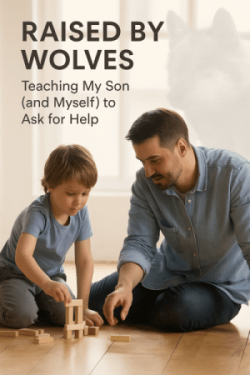
Raised by Wolves – Teaching My Son (and Myself) to Ask for Help

By The Mindful Dad Life.

This story is part 2 of a series of posts that need to be written, both for my own reflections and to help me understand what kind of dad I want to be.

I started noticing it when my son was about four or five. He’d be sitting on the floor with his blocks, or drawing something he’d never tried before, and I could see him struggling—jaw tight, shoulders stiff, refusing to look my way. He wouldn’t ask for help.

And I recognized it instantly, because I was looking at myself.

I’ve spent most of my life with that same instinct, the one that whispers, figure it out yourself, don’t bother anyone, don’t show weakness. I never taught him that, not intentionally, but kids don’t just learn what we say; they pick up who we are. In a lot of ways, we pass on survival habits without even meaning to. Raised by wolves, indeed.

It took weeks “Weeks” of patient conversations to help him get comfortable asking. I’d sit beside him and say, “What can you figure out, and what can I help you with?” or “If you need help, remember, I’m right here.” At first, he’d shake his head and try harder on his own. But slowly, he started asking. Just once in a while at first, then with a little more ease.

And every time he asked, it felt like a small victory, not just for him, but for both of us.

Because if I’m being honest, I’m still learning this myself.

The Freeze

Not long ago, a friend of mine—someone I’d just helped with his art business plan and a new logo he’d been wanting for years—looked me straight in the eye and said, “Anything you need, man, just ask.”

I froze.

My mind went completely blank. Not because I didn’t need help, but because my brain didn’t know how to process that offer. I didn’t know what to say. And that’s when it hit me: this isn’t just habit, it’s wiring.

Why Men Struggle to Ask for Help

Science backs that up. Studies have shown that men are less likely than women to seek help, not just emotionally but practically, whether it’s asking for directions, reaching out for mental health support, or delegating tasks.

Some of this comes from how boys are socialized. Research published in Psychology of Men & Masculinities found that from a young age, boys are more likely to be praised for independence and problem-solving, while girls are encouraged to seek and offer help. By the time we’re adults, those patterns are deeply ingrained.

There’s also biology at play. A 2019 review in Frontiers in Behavioral Neuroscience discussed how testosterone and stress responses interact, often making men more likely to respond to challenges with a “fight-or-flight” reaction rather than a “tend-and-befriend” one, a pattern more common in women. In other words, when something’s hard, our instinct isn’t to ask for help; it’s to grit our teeth and push harder.

That instinct kept our ancestors alive. But for fathers, for men trying to raise kids in a healthier, more connected world, it can hold us back.

The New Pack

I don’t want to raise my son to be a lone wolf. I want him to know that asking for help isn’t weakness, it’s trust. It’s connection. It’s how we build stronger families, stronger friendships, stronger lives.

The truth is, we’re not meant to do it all alone. Wolves survive in packs for a reason.

So I’m trying to rewrite this for myself as much as for him. I’m practicing saying yes when someone offers to help, even if it feels awkward. I’m practicing asking for help before things reach the breaking point. And every time my son looks up and says, “Dad, can you help me with this?” I remind myself: this is what breaking the cycle looks like.

If I can teach him that strength isn’t just doing everything alone, then maybe that’s the legacy that matters most.


For Dads Reading This

If you’re like me, you probably freeze up too. Maybe you think you need to handle everything, to be the strong one all the time. But the strongest thing you can teach your kids is that strength also looks like leaning on people you trust.

Start small. Accept help when it’s offered. Ask for help in one thing this week, even if it feels uncomfortable. Show your kids that trust is strength.

Because we weren’t meant to do this alone. And neither are they.

When Tightening the Reins Backfires – Quick Parenting Tips


Tightening the reins too much can turn a small attitude problem into a power struggle. Here’s how to stay calm, offer choices, and build trust with your kids.


Kids push back harder when they feel powerless. Tightening the reins too much can turn a small attitude problem into a full-on power struggle. Here’s how to stay calm and keep the connection strong:


✅ 1. Pause Before Reacting

Take a breath before laying down a consequence. A calm response works better than a sharp one.


✅ 2. Ask What’s Behind the Attitude

Is your child tired, frustrated, or just needing to feel some control? Figuring this out changes how you respond.


✅ 3. Offer Choices Within Boundaries

Instead of “That’s it, you’re done,” try saying something like:
“Do you need a quick break, or should we wrap this up now? It’s your choice.”

Kids often relax faster when they feel included in the decision.


✅ 4. Let Go of Needing to “Win”

Parenting isn’t about winning every moment—it’s about building trust. The more curious and patient you are, the quicker the attitude melts away.


Parenting isn’t about perfection—it’s about showing up, time and again, and growing right alongside your kids.

Win-Win Parenting: Teaching Kids Negotiation Skills at Every Age

Win-Win Parenting: Teaching Kids Negotiation Skills at Every Age

My son didn’t think he was getting a good deal. I had just told him we were turning off the TV, and I could see his frustration. In his mind, this was a classic win-lose situation; I was winning, and he was definitely losing.

But instead of brushing it off or giving in, I said, “Let’s make a deal. We’ll shut it off now, and then we can head to the greenhouse and do something fun.”

Thirty minutes later, we were both soaked from head to toe, laughing so hard we could barely catch our breath, locked in one of the most epic water gun fights we’ve ever had. Afterward, sitting in his fort, I asked him, “Which was better, staying inside watching TV or having a water gun fight?” He grinned and said, “Okay, this was way better than TV.”

I said, “win-win,” and he agreed. It’s a skill I’ve been building in him since he first learned the word “No.” As adults, we sometimes have to make choices our kids won’t like, but when we take the time to frame those choices in a way that works for both of us, they learn a valuable lesson, and we’re no longer just the “mean parent” always telling them what to do.


Why Win-Win Thinking Matters for Kids

Most adults grew up believing someone has to lose for someone else to win. But real life—friendships, marriages, workplaces—works better when we collaborate.

Teaching kids to think in win-win terms helps them:

  • Solve conflicts with less drama
  • Build empathy by considering others’ needs
  • Develop problem-solving and leadership skills
  • Feel more confident because they learn they can influence outcomes

And here’s the hidden benefit: Win-win thinking also teaches kids emotional regulation. They learn to pause, think through options, and manage big feelings instead of reacting impulsively.

The good news? You can start teaching this at any age. It just takes patience—and a willingness to model it yourself (even when you don’t feel like it).


Stage-by-Stage: How to Teach Kids Win-Win Negotiation

Start using the term win-win early. Explain that you want to work together to find solutions where both of you feel good about the outcome. Talking about win-lose situations helps too—showing the contrast makes it clear they have choices and can influence how things turn out.

And don’t worry—you won’t get it perfect every time. I’ve had my share of “because I said so” moments that ended in tears instead of solutions. But each time I slow down and involve my son, I see how powerful this really is.

Ages 3–5: Sharing and Fairness

At this age, kids are just beginning to understand fairness.

What to teach:

  • Taking turns and simple sharing
  • Naming feelings: “You’re upset because you want the toy too, right?”
  • Basic fairness: “You play for five minutes, then he plays for five minutes.”

Example: Two kids want the same truck. You guide them: “How about you play while the timer runs, then switch? That way you both get a turn.”


Ages 6–8: Solving Problems Together

Kids start to understand that problems have more than one solution.

What to teach:

  • Asking questions: “What do you want? What do I want? What works for both of us?”
  • Writing or drawing choices so they can see options

Example: Choosing a family game. “You want Uno, I want chess. Let’s list our favorite games and pick one we both like, or we can play both, one after the other.”


Ages 9–12: Creative Win-Win Thinking

Older kids can start brainstorming solutions and understanding trade-offs.

What to teach:

  • Thinking of more than one possible solution
  • Understanding long-term fairness (“If you sit there this time, they sit there next time”)

Example: Two siblings fight over who gets the best car seat. Instead of deciding for them, ask: “What’s a fair way to handle this today and next time?”


Teens: Real-Life Negotiation

Teenagers are ready for real negotiation practice—especially when it involves something they care about.

What to teach:

  • Presenting their case respectfully
  • Taking responsibility for the outcome

Example: Your teen wants a later curfew. Instead of saying “No,” ask: “How will you make sure mornings still work if we agree to this?” Let them propose a solution, then hold them accountable.


The Long Game: Raising Problem-Solvers, Not Power-Strugglers

The greenhouse water-gun fight with my son wasn’t just about getting him off the TV. It was about showing him that sometimes, the thing you think is a loss can actually turn into the best part of your day.

I’ve had the opposite happen too—times I stuck with “because I said so” instead of listening. Those moments ended in frustration for both of us. But when I slow down and let him help solve the problem, I see him growing, not just happier, but more thoughtful and confident. It’s the same lesson as earlier: when we frame choices as win-win, kids feel respected and learn to look for better solutions.

Kids who learn win-win negotiation don’t just get better at resolving sibling fights or bedtime arguments. They grow into adults who build better relationships, handle conflict with empathy, and look for solutions instead of someone to blame.

And that’s a win for everyone.


Quick Parent Cheatsheet: Say This, Not That

Say: “What’s a way we can both be happy with this?”
Not: “Because I said so.”

Say: “What do you want, and what do I want?”
Not: “You’ll do it my way or not at all.”

Say: “What’s fair for everyone?”
Not: “Stop arguing and just share.”

Use these small shifts, and you’ll be surprised how quickly kids catch on.


Want More Mindful Parenting Tips?

If you enjoyed this, follow along at Mindful Dad Life—where we’re learning to raise emotionally intelligent kids (and sometimes learning right alongside them).