How My Child’s Bedtime Question Redefined My Understanding of Love, Parenting, Connection, and What Gives Life Meaning

A Father’s Journey Into Stoic Parenting — How One Bedtime Question Transformed My View of Love, Connection, and Raising Resilient Kids

This is Part 5 of a now 5-part series on incorporating Stoic principles into my and my son’s lives. Each post explores one of the core Stoic virtues — this final reflection centers on Connection, the roots that keep the virtues alive and the wings that carry them into the world.

Love is more than words.
Connection is how love becomes real — roots that nourish us, wings that let us grow.


The Roots and Wings of Connection

When I tell my son I love him, sometimes he pauses. One night, when he was younger, he looked up at me and asked, “What does that even mean?”

It stopped me in my tracks. Adults throw around “I love you” all the time, but for a child, those words require clarity. So, I told him: “It means I care about you, and I want the very best for you.”

He nodded. And I’ve returned to that definition ever since. Because love — real love — is more than a feeling. It’s a way of living.

The Stoics called this oikeiôsis — the natural widening of care. I picture it as roots and wings:

  • Roots hold us steady — first in ourselves, then in family, then in those closest to us.
  • Wings carry us outward — to friends, community, and eventually to all of humanity and the natural world.

Roots give us nourishment. Wings give us possibility. Both are needed if the virtues are to thrive.


The Parent’s Paradox

As parents, we often hear that love means sacrifice — giving all of ourselves to our children. And yes, in many ways we do sacrifice. But real love doesn’t come from a parent who is constantly running on empty.

It comes from a parent who has cared for themselves enough to have something true to give. By tending to our own roots — our minds, bodies, and hearts — we show our children that love is strongest when it flows from fullness, not exhaustion.


A Caution About Connection

Not every connection nourishes. Some soil is thin or poisoned. Some wings are clipped by those who wish to control rather than care. I am reminded that not every bond is healthy. Some connections weaken us, leaving us drained or diminished. Yet even then, a quiet strength within us often remains — roots that still hold, wings that still long to spread.

True connection is not about staying tied to what harms us. It’s about choosing the soil and the sky that let us grow. We need to teach our children to not only reach out and open up, but to connect wisely to those who will nourish them…


The Virtues in Roots and Wings

The Stoics taught four cardinal virtues. Each one lives when it is rooted in care and lifted by connection:

  • Wisdom: Knowing what matters and where our control ends. I learned this in the early mornings — a glass of water in my hand, my son already on the couch with his iPad. I couldn’t control his mood or every choice, but I could control how I showed up. When I chose presence over pressure and rhythm over rigidity, the morning softened. Wisdom roots us in what we can truly influence and lets the rest go.
  • Courage: Acting rightly even when afraid. One night after a school event, the dark felt bigger than usual. I asked my son to stay close — not to scare him, but to keep him aware, safe. Later, he said, “Kids are pretty helpless.” I told him courage isn’t the absence of fear; it’s the choice to take the braver step anyway. Courage is the lift of the wings — steady, quiet, strong.
  • Justice: Doing what’s right, especially when no one is watching. Fairness is the compass; justice is the way we walk with it. It’s the small daily choices — keeping our word, owning our mistakes, treating people with respect — that build trust. Justice stretches our wings into the lives of others and keeps our roots intertwined with integrity.
  • Temperance: Knowing when enough is enough. I learned this through the “just one more” bedtime battles — one more story, one more snack, one more video. The easy path was to give in. Real love was holding the line with presence and care, teaching that limits are protection, not punishment. Temperance balances our roots, keeping us grounded, and our wings, giving us guidance — setting boundaries that let us grow strong and free.

And here’s the truth I’ve come to see as a father: none of these virtues stand alone. They only live and breathe when they are nourished by roots and carried by wings — when connection gives them purpose. Without connection to others, these virtues are brittle rules. With connection, they become love in action, woven into how we live and how we raise our children.


A Tool for Both of Us

At night, or in a quiet moment, pause and ask:

  1. What rooted me today? (What strengthened me in body, mind, or heart?)
  2. “Who was in my circle today? Who did I care for? Who cared for me?”
  3. How did I help another take flight? (Where did I encourage, include, or lift someone else?)
  4. And then widen it — just a little.

Reach out. Show kindness. Notice someone you might not have before.

Because every time you stretch the circle, life grows a little fuller.


Try This Tomorrow

For You: Notice one moment where you feel the pull to over-give or run on empty. Pause, and choose one small act of self-care instead — a breath, a walk, a kind word to yourself. Protect your roots.

Together: Ask your child who or what made them feel strong or cared for today — their roots. Then ask who they encouraged or lifted up — their wings. Share your own answers. Show them how connection moves in both directions.


Final Thought

When I say “I love you” to my son, I want him to feel it as both roots that nourish him and wings that lift him — steady enough to hold him, strong enough to let him fly, always giving him the courage to grow.

That’s the lesson I want him to carry as he grows: love is the roots and wings that hold everything together. Life is about who we’re connected to, how we draw strength from them, and how we lift them up in return.

Call to Action

If this reflection spoke to you, take it with you into tomorrow. Share it with another parent, a friend, or even with your child. Begin the conversation: What are your roots? Who are your wings?


Connection deepens when we name it, nurture it, and live it out loud. That’s how we build lives — and families — that hold steady and help each other soar.

The Raincoat Fight I Didn’t Win — and Why I’m Glad I Didn’t

A story about parenting, trust, and the quiet strength of letting go of control.

By: A Mindful Dad’s Life

Last Thursday morning started with a drizzle and a dilemma.
Not heavy rain — just that fine mist that lingers in the air and makes everything feel damp.

Before we even finished breakfast, I got a text from the school:

“Please remember to send your kids to school with clothing appropriate for the weather as we hope to get outside today!!!”

Triple exclamation points. Message received.

I looked at my son, my 8-year-old, full of energy and opinions. His raincoat was already waiting by the door. But instead of slipping it on like I’d hoped, he tossed it over his shoulder and said flatly:

“I don’t want to wear it.”

I kept it calm.
“It’s wet out today. You might get cold.”

That’s when he looked up at me and said something I didn’t expect:

“I know my body better than you do.”

He didn’t say it to be rude. There was no attitude in his voice.
Just a simple, honest statement of belief. One that made me pause more than I care to admit.


The Crossroads

Many of us have been raised with the story that when kids push back like this — and probably in the minds of those three-exclamation-point school staff — I was supposed to “be the parent.”

Lay down the law.
Insist on the coat.
Prove that I know what’s best.

But here’s the thing: I’ve been trying to raise my son to listen to himself.
To pay attention to what his body feels, to what his instincts tell him, and to trust his own judgment — even when it contradicts mine.

So this was the moment of truth:
Do I trust my son enough to let him be wrong?

Do I respect him enough to let him have a voice?
Do I trust him enough to let him be right, even when it challenges my authority?


The Walk to School

The coat didn’t stay on the hook — but it didn’t go on his back either. It landed in his backpack, right where we both agreed it should be. I am, after all, also trying to teach him to always be prepared.
We walked together in the light drizzle. He was fine.
Maybe a little wet by the time we reached the school doors — but smiling. Confident. Proud.

And me? I didn’t feel like I’d lost the raincoat fight.
I felt like I’d just passed a different kind of test.


The Bigger Picture

This wasn’t about a coat.
It was about trust. Autonomy.
It was about making space for a child to begin becoming who they are — not just who we tell them to be.

The world will give my son plenty of opportunities to conform.
It will try to tell him what to wear, what to think, how to feel.

But in this house — in this moment — I want him to know what it feels like to be trusted.

Because if he learns that now,
maybe someday, when someone tries to control him through fear or shame or pressure…
he’ll remember what it felt like to say, “I know my body (and myself) better than you do.”

And he’ll believe it.


Closing Reflection

Some days, parenting isn’t about teaching your child what to do.
It’s about showing them what it looks like to trust themself — and to trust others.

Even when the school text says otherwise.
Even when you’re afraid they’ll get cold.
Even when you want to be in control.

The raincoat stayed in his backpack for the day.
And Bear walked tall.
That’s a win in my book.

Ready to Date Again, Part 2: Owning My Part, Rewriting the Future

Tonight, I could have gone to the LL Bean concert. It would have been easy, light, maybe even fun. But I stayed home instead. Not because I didn’t want to be around people, but because I felt the pull to write this, to sit with myself, to reflect, and to be honest about where I’ve been and where I want to go.

The first post in this series was about stepping back into the dating world as a parent. This one goes deeper. It’s not about how or when to introduce someone to your kids. It’s about the harder truth: the last relationship didn’t work out. And part of that was on me.


My Last Relationship Didn’t Work — And I was half the reason why.

It’s easy, by default, to focus on what the other person did wrong when a relationship ends. But when I look back, I see moments where I shut down when I could have opened up. Times I focused so much on providing and protecting that I forgot to connect. Times I avoided conflict instead of working through it. Times I expected her to read my mind, rather than speak clearly and kindly.

I didn’t mean to pull away. I thought I was doing what needed to be done. Paying the bills, holding the line, making sure everything kept moving. But emotional neglect doesn’t always look like cruelty. Sometimes it just looks like distance. I realized I wasn’t speaking the love languages she needed to hear, just as she wasn’t speaking mine. And the distance that placed between us made the chances we had to connect fewer and farther in between.

Psychologist Dr. John Gottman calls these missed moments “emotional bids”. They are small ways that we reach out for connection, often without realizing it. In strong relationships, those bids are met with attention and care. But when they’re overlooked too often, disconnection grows. I see now how many of those small moments I missed.

Being a dad requires presence, patience, and honesty. It means showing up every day not with all the answers, but with the willingness to learn, to try again, and to admit when I’ve messed up. It means letting my son see that being strong includes saying ‘I’m sorry’ and asking, ‘How can I do better?’

Being a partner requires softness too; openness, vulnerability, and the ability to let someone else in. I didn’t always balance those well. I used to think I had to pick one or the other, either be the steady, reliable dad or the emotionally available partner. I didn’t realize that real strength includes the courage to be open, to admit when I’m overwhelmed, and to let someone in even when it’s uncomfortable. Carrying the weight alone felt noble at the time, but now I see it just kept me at a distance from the very connection I was craving. I see now that real strength is making space for softness too. It’s knowing when to hold steady and when to let someone hold you. I’m still learning how to do both at the same time, and how important that balance is for the kind of love I want to build.


What I Want Now—And What I’m Still Learning

When I met my son’s mom, I wasn’t looking for someone to complete me, but I was looking for companionship, for connection, and for a place to belong. I wanted to be a part of her life, and I thought love would be enough to figure the rest out as we went. But I didn’t fully understand what I needed, or what I was bringing into the relationship.

Now, I’m looking for something deeper. I want to grow with someone. I want to build something real, a partnership that makes space for truth, joy, laughter, and healing. I want to show up fully. I want to be heard, and I want to listen with intention. I want a love that isn’t afraid of hard conversations, and laughter that lasts longer than the moment. A love that evolves with us, not in spite of us. I want to build a relationship rooted in shared goals and values, not one weighed down or defined by unnecessary drama.

I also know that I need to slow down and listen when the person I choose to be with has something important to say. And give them the grace to hear what it is they are really saying, without rushing to interpret or filter it through my own lens. It’s tough sometimes to sit through the noise; we, as humans, aren’t really taught to share our emotions in ways that invite connection and safety. Neuroscience shows that our brains are wired for survival, not vulnerability. When we feel emotionally unsafe, even without realizing it, our nervous systems can go into fight, flight, or freeze. To truly connect, we need to feel emotionally safe, and that requires listening not to reply, but to understand. I’m still learning how to do that.

Fatherhood, too, has changed me. It taught me that presence matters more than perfection. That patience is love in action. That saying “I’m here” means more than any grand gesture. Although I will probably bring home flowers every now and then anyway.

And it’s taught me that who I choose to invite into our life matters deeply. Not just for me, but for my son.


Forgiveness and Forward Motion

I don’t carry shame about the past, but I do carry responsibility. That’s the price of growth. And it’s also the gift.

I’m learning to forgive myself for the moments I missed and to honor the lessons they left behind. I’m not rushing into anything, but I’m not closed off either. I’m open to something beautiful. Something honest. Something worth the wait.

Because I’m not looking for perfect. I’m looking for kind. I’m looking for safe. I’m looking for a soft place to land.


Closing Thoughts

The question of when to introduce someone to my son still matters. But that question comes after this one: Who am I becoming? It starts here, with reflection. With acknowledgment of where I’ve been and how I want to show up differently. And with making sure that when I do invite someone into our life, it’s because I’m ready to bring my whole self to the table, present, open, and aware.

If you’ve been through heartbreak too, what would you do differently next time—not by changing who you are with, but by changing something that needs to grow in you?

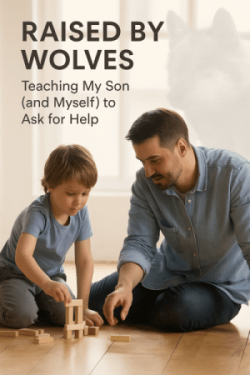
Raised by Wolves – Teaching My Son (and Myself) to Ask for Help

By The Mindful Dad Life.

This story is part 2 of a series of posts that need to be written, both for my own reflections and to help me understand what kind of dad I want to be.

I started noticing it when my son was about four or five. He’d be sitting on the floor with his blocks, or drawing something he’d never tried before, and I could see him struggling—jaw tight, shoulders stiff, refusing to look my way. He wouldn’t ask for help.

And I recognized it instantly, because I was looking at myself.

I’ve spent most of my life with that same instinct, the one that whispers, figure it out yourself, don’t bother anyone, don’t show weakness. I never taught him that, not intentionally, but kids don’t just learn what we say; they pick up who we are. In a lot of ways, we pass on survival habits without even meaning to. Raised by wolves, indeed.

It took weeks “Weeks” of patient conversations to help him get comfortable asking. I’d sit beside him and say, “What can you figure out, and what can I help you with?” or “If you need help, remember, I’m right here.” At first, he’d shake his head and try harder on his own. But slowly, he started asking. Just once in a while at first, then with a little more ease.

And every time he asked, it felt like a small victory, not just for him, but for both of us.

Because if I’m being honest, I’m still learning this myself.

The Freeze

Not long ago, a friend of mine—someone I’d just helped with his art business plan and a new logo he’d been wanting for years—looked me straight in the eye and said, “Anything you need, man, just ask.”

I froze.

My mind went completely blank. Not because I didn’t need help, but because my brain didn’t know how to process that offer. I didn’t know what to say. And that’s when it hit me: this isn’t just habit, it’s wiring.

Why Men Struggle to Ask for Help

Science backs that up. Studies have shown that men are less likely than women to seek help, not just emotionally but practically, whether it’s asking for directions, reaching out for mental health support, or delegating tasks.

Some of this comes from how boys are socialized. Research published in Psychology of Men & Masculinities found that from a young age, boys are more likely to be praised for independence and problem-solving, while girls are encouraged to seek and offer help. By the time we’re adults, those patterns are deeply ingrained.

There’s also biology at play. A 2019 review in Frontiers in Behavioral Neuroscience discussed how testosterone and stress responses interact, often making men more likely to respond to challenges with a “fight-or-flight” reaction rather than a “tend-and-befriend” one, a pattern more common in women. In other words, when something’s hard, our instinct isn’t to ask for help; it’s to grit our teeth and push harder.

That instinct kept our ancestors alive. But for fathers, for men trying to raise kids in a healthier, more connected world, it can hold us back.

The New Pack

I don’t want to raise my son to be a lone wolf. I want him to know that asking for help isn’t weakness, it’s trust. It’s connection. It’s how we build stronger families, stronger friendships, stronger lives.

The truth is, we’re not meant to do it all alone. Wolves survive in packs for a reason.

So I’m trying to rewrite this for myself as much as for him. I’m practicing saying yes when someone offers to help, even if it feels awkward. I’m practicing asking for help before things reach the breaking point. And every time my son looks up and says, “Dad, can you help me with this?” I remind myself: this is what breaking the cycle looks like.

If I can teach him that strength isn’t just doing everything alone, then maybe that’s the legacy that matters most.


For Dads Reading This

If you’re like me, you probably freeze up too. Maybe you think you need to handle everything, to be the strong one all the time. But the strongest thing you can teach your kids is that strength also looks like leaning on people you trust.

Start small. Accept help when it’s offered. Ask for help in one thing this week, even if it feels uncomfortable. Show your kids that trust is strength.

Because we weren’t meant to do this alone. And neither are they.

The Pause That Changed Everything: When My Son’s Anger Wasn’t About Me

We were rushing out the door for a track meet when I ran back inside to grab a couple of warm shirts. At the last meet, it had rained and the temperature dropped 15 degrees. Everyone else had sweatshirts and raincoats—except for me, my son, and a few other parents who hadn’t thought to check the forecast. This time, I wanted to be prepared.

On the way home, my son mentioned that it was a good thing I had put the shirt he didn’t want to wear back in the house, like he thought he had told me. I told him I didn’t hear him say that and hadn’t put the shirt back—I had brought it with us, just in case. I explained that I could put it away once we got home.

That’s when he got upset. Not just annoyed—he lost it. He yelled at me for bringing the shirt he didn’t want. I had thought I was being helpful, but to him, it felt like I hadn’t listened. He started crying and yelling:

“You never listen to me!”

It stung. I wanted to defend myself. I wanted to say, “I was just trying to help.”
But I didn’t.

Later that evening, he came barreling out of the bathroom, furious again.

“Don’t ever put the toothpaste there again!”

This time, I knew I hadn’t touched the toothpaste. I tried to explain that I use a different kind, that it must’ve been someone else. But the more I talked, the angrier he got.

So I stopped.

I knelt down, put my hand gently on his shoulder, and asked, “Are you OK?”
Then I added softly, “You’ve been getting really angry with me lately. Is everything OK?”

And just like that, he softened.

His shoulders dropped. His breathing slowed. He listened while I explained about the toothpaste. I didn’t move his, and then I helped him open the tube and let him squeeze it onto his toothbrush himself.

No lecture. No power struggle. Just presence.


What I’m Learning as a Dad

Kids lash out. It doesn’t mean they’re bad. It doesn’t mean we’ve failed. And it doesn’t always mean we should push back.

Sometimes the outburst isn’t about the shirt or the toothpaste. Sometimes it’s about a hard day, a tired body, or feelings they can’t yet name.
Sometimes, what they need most is a dad who pauses. Who listens. Who sees through the storm.


The Power of the Pause

That moment reminded me: connection comes before correction. Every time.
And when I choose curiosity over control, I get to be more than just a rule-enforcer; I get to be a safe place.

A place where my son can be angry and still be loved.
Where he can make mistakes and still be met with grace.
Where he can be small and growing and full of emotions, and still be seen.

That’s the kind of dad I’m learning to be.
One pause at a time.

If this landed with you, share it with someone who’s parenting through the hard moments. Let’s remind each other: presence matters.