
Fear Is Not the Enemy—It’s the Doorway to Growth
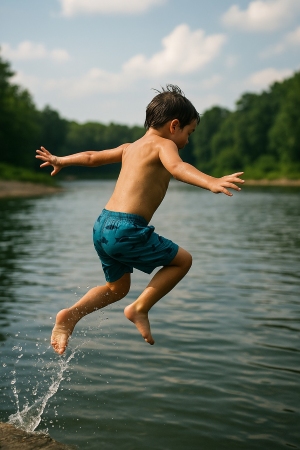
Last summer, my son wasn’t ready to swim on his own. To break up a long drive on a hot day, we went to a calm, safe spot on the Saco River where I could dive in for a swim. He stayed on shore, watching. I offered to give him a ride on my back, but he shook his head no. Instead, he pointed to the rocks lining the river, seeing if I would jump from any rock he pointed to. He laughed as I jumped, each time asking me to go higher. Every splash was met with wide-eyed wonder, but he never came close to the edge.
Fast forward to this past Sunday. We went back to the same spot along the river, and I inflated a tube for him to float in. At first, I tied it to our dog’s harness and let her swim alongside me as she pulled him along. That worked well for about five minutes, until he started splashing her and she swam around in circles, then headed for shore. After unhooking her, she and I dove back in, her harness slung securely over my shoulder. We went downriver for 20–25 minutes before I pulled his float over to a small rock outcropping, where we had to climb up to get out of the river. I stood on a rock, maybe four or five feet above the water, and told him I was going to jump. He watched closely as I launched myself off, came up whooping and laughing, water streaming down my face.
This time, something shifted. He said he wanted to try.
He walked to the edge and peered down. “It looks really scary,” he told me.
And I believed him. Fear is real, especially the first time you stand at the edge of something unknown. I told him that sometimes everyone needs to do something that scares them. In truth, being scared and pushing past that fear helps reset our stress baseline, builds resilience, and strengthens our ability to grow. Research in developmental psychology and neuroscience supports that facing manageable fears promotes confidence, problem‑solving, and long‑term emotional regulation.
I treaded water and waited, watching my son as he closed his eyes… and leapt.
I was right there to catch him, but he didn’t need me. He came up from the water looking shocked, amazed, and, more than anything, proud. His face lit up with joy, the kind of joy that only comes when you’ve pushed past fear and realized you are stronger than you thought.
We climbed back up together, and this time he told me he was going to jump even higher. He smiled the whole way down, grinning until he hit the water.
A Small Moment at the YMCA
Just tonight, I was leaving the Y when I noticed a girl about my son’s age climbing over the top rail that surrounds the indoor track. She was working hard, stretching and pulling herself up, smiling as she went.
Her parent quickly said, “No, that’s not what that’s for.” The little girl climbed back down and slid between the rails instead, where it was safer.
I don’t think her parent did anything wrong; they were keeping her safe and setting an expectation. But I couldn’t help wondering what lesson the girl took away. Was it that climbing was dangerous? Or that the joy of effort isn’t worth the risk?
I thought of how many times I’ve let my son climb fences or rails higher than that, and how much confidence he’s gained from it. It reminded me that part of parenting is choosing carefully which fears to protect against, and which ones to let our kids meet head-on.
The Lesson
Fear is not the enemy. It’s an invitation to growth.
When kids do something that scares them—not recklessly, but with support—they learn that fear doesn’t have to stop them. They learn that courage is built in moments like this, when your heart races and your legs want to turn back, but you leap anyway.
And maybe most importantly, they learn to trust themselves.
💡 Parent takeaway: The next time your child hesitates at the edge of something new, don’t rush to pull them back. Stand beside them, believe their fear, and remind them: sometimes the scariest leaps turn into the best memories.
 Mindful Dad Life