Seeing the World Through a Child’s Sense of Fairness

What One Morning Taught Me About Justice, Integrity, and the Quiet Power of Doing What’s Right

This is Part 3 of a 4-part series on incorporating Stoic principles into the life of my son. Each post explores one of the core Stoic virtues — continuing with Justice.

Fairness is a compass.
Justice is the way we walk with it.


We were getting ready for school one morning — a little behind, a little foggy in the head. I was pouring coffee when Bear came into the kitchen with a look that told me something was coming.

“Dad,” he said, calm but firm,
“you said we both have to make our beds before breakfast… but you didn’t make yours.”

He wasn’t trying to catch me.
He wasn’t being rude.
He was holding me to the same standard I’d set for him.

And he was right.

Not long ago, I might’ve brushed it off.
Told him, “Focus on what you’re supposed to do.”
Or given the classic adult line — I was busy. I’ll get to it later.

But my son has always had a strong sense of fairness.
At school.
On the playground.
In our home.

That morning, he wasn’t just focused on himself.
He was focused on both of us doing what we say.


Justice Isn’t Just for Judges

The Stoics believed Justice wasn’t about laws and punishments —
It was about how we live.
How we treat people.
How we show up, even when it’s inconvenient.

My son had already figured that out.

If someone cut in line, he noticed.
If a classmate got blamed unfairly, he spoke up.
If I skipped a step I said was important, he called it out — not to be difficult, but because it mattered to him.

And I almost crushed that instinct.

Not on purpose.

At first, when he pointed out things he thought were unfair,
I’d tell him to just focus on himself.
That he was in charge of himself and let others be in charge of themselves.
That he can’t control other people.

Which is true —
but not the whole truth.

Because kids see deeply.
They feel when something is off.
They care when things aren’t right.

And when we dismiss that…
We risk teaching them to stop caring.

What my son needed wasn’t to be silenced.
He needed help understanding what he was seeing.
Help learning how to move through the world where fairness matters —
But so does grace.
So does compassion.

Justice doesn’t mean policing the world.
It means walking through it with integrity.


A Daily Reset

So now we do a check-in each afternoon or evening.

Not just:
“Did you brush your teeth?”
But:
“Did we clean up after ourselves?”
“Were we respectful?”
“Did anything happen today that you want to talk about or felt wasn’t right?”

Then we talk about it,

really talk about it, and figure out how we felt and what he or I might have done differently next time.

And I give him the grace to say what he’s feeling or thinking, and if I feel he needs a different way of seeing what happened, I’ll steer the conversation in a way that helps him understand.

Because in his eyes —
and honestly, in mine too —

How you do one thing is how you do everything.

And the way we reflect on those things together —
honestly, openly, without shame —
that’s how we build the sense of justice,
one small moment at a time.


Try This Tomorrow:

For You:
Notice one moment where you could act with more fairness — especially when no one’s watching. Choose integrity. Follow through.

Together:
Ask your child to share something that felt unfair today. Then talk through it — not to fix it, but to understand it together. Talk about what integrity might look like next time.


Final Thought

Justice begins in small, quiet places.
A made bed.
An honest word.
A promise kept.

That’s where your child learns it.
And that’s how you show them the path forward.

Step by step.
Side by side.

Fall, Fatherhood, and Embracing Change

For me, Fall always brings a mix of melancholy and excitement. It means saying goodbye to Summer, but also welcoming back the cool nights, crisp mornings, and warm days of Autumn. I look forward to the blaze of colour in the trees, the earlier dusk, and the quiet comfort of Fall nights.

This year, though, the season feels different. With my son’s time now shared between his mother and me, the familiar rhythm of our traditions has shifted. I feel the absence of what we used to do together, like apple picking, pumpkin carving, and hikes on trails littered with golden leaves. These memories still live in me, but they also remind me of what’s changed.

It would be easy to sit in that loss. To focus on what isn’t the same anymore. But Fall itself is all about change; it embodies it. So, I’ve decided this is the year to create new rituals with my son.

Some will be echoes of the old. We’ll go apple picking together, even if it means he’s already been with his mom. It doesn’t matter how many times you walk through an orchard in September, each trip carries its own memories. We can make it ours by turning it into a tradition: maybe we pick a “dad and son” apple that we always eat right there in the field, juice running down our arms. Maybe we can bring home the extras and bake a pie together, even if it ends up looking more like a science experiment than dessert. As long as we have whipped cream, it’ll be delicious.

Pumpkin carving will stay on the list, too. But this year, I’ll turn it into a road trip. We’ll pick a place we haven’t been before and drive to get a pumpkin. We’ll discover the local attractions and turn it into a mini adventure. We’ll take a picture of the jack-o-lantern with the candle glowing inside and put that picture on the wall for the season. It’ll be a new ritual that’s less about the pumpkin and more about expanding our horizons.

And of course, Halloween. He loves dressing up in a scary costume and running around the neighborhood with his friends, running from house to house for candy, and experiencing the thrill of the night. I’ll let him lead the charge on costumes, even if that means I end up being the sidekick to whatever villainous monster he becomes. That’s part of the fun, stepping into his world for an evening, letting the night be about his imagination.

But I also want new rituals that reflect where we are now. A fall hike, just the two of us, where we bring a small notebook and sketch or jot down what we notice, maybe the way the leaves crunch, the smell of pine needles, the silence broken by a distant crow. Or a night walk under the earlier stars, where we’ll talk about how the world shifts around us when the seasons change.

And Thanksgiving; I want that to mean something deeper than just food. I’d like us to volunteer together, maybe at a food pantry or community dinner. I don’t know where yet, but I know the act of serving side by side will teach him more than any conversation ever could. Gratitude isn’t just something you feel; it’s something you practice.

We’ll pick…

The truth is, I don’t want to design these traditions for him anymore. He’s older now, old enough to help create them. So I plan to sit down with him and ask: What do you want our Fall traditions to be? Which ones do you love, and what new ones should we invent? I want him to feel that sense of ownership, that what we’re building is ours, not just mine, handed down to him.

Fall itself is a season of transition — the trees letting go of what they no longer need, the days shifting toward rest. This year, I’m going to let that change mirror my own. I can’t hold on to the past, but I can shape the future: one ritual, one memory, one shared moment at a time.

Maybe that’s what Fall is really teaching me, that there is true beauty inherent in change, and that letting go is not the end of something, but the beginning of something new.

🍁 A Call to Other Parents

If you’re a parent, especially one navigating shared time, I’d love to hear from you: What Fall rituals do you and your children keep, and which new ones have you created? How do you turn seasons of change into seasons of connection? Share your traditions; maybe they’ll inspire new ones for the rest of us.

#Parenting,  #Fatherhood,  #DadLife, #SingleParenting,  #CoParenting, #FamilyTraditions, #FallVibes, #AutumnVibes, #FallFeels, #CreatingMemories

Some Days Are Just Harder – And That’s Okay

Some days hit harder as a parent. This week, I had one of those days.

It’s the first full week of summer vacation, and my son and I have slightly different visions of what that means. I’ve been trying to keep a balance—structure without being rigid, free time without falling into too much screen time. During the school year, I created no-screen Sundays and Wednesdays to set aside time for connection: bouncing on the trampoline, Beyblade battles, or just being silly together. Some mornings, he’d sneak in early iPad time. I let it slide occasionally, telling myself I was being flexible rather than inconsistent. But I stayed firm on evenings and weekends.

Now it’s summer. More time, more freedom, and more friction.

This morning, we woke up together, and he went right for the iPad. I reminded him it was a no-screen day. He seemed okay with that while I made breakfast and packed lunch for camp. Lately, we’ve had a nightly tradition: 10–15 minutes of Minecraft before bed. But the night before, we didn’t get to it—track practice ran late, I had an extra errand, and bedtime came fast. I apologized to him for my part in getting him off the field later than I’d planned. I knew he was disappointed.

I’ve taught my son to think in terms of win-win solutions. So he suggested we play Minecraft together the next morning before camp. That felt fair, and we agreed.

He’d just come back from a weekend with his mom, visiting cousins in New York and staying up late every night. He was tired, off-rhythm, and emotionally frayed.

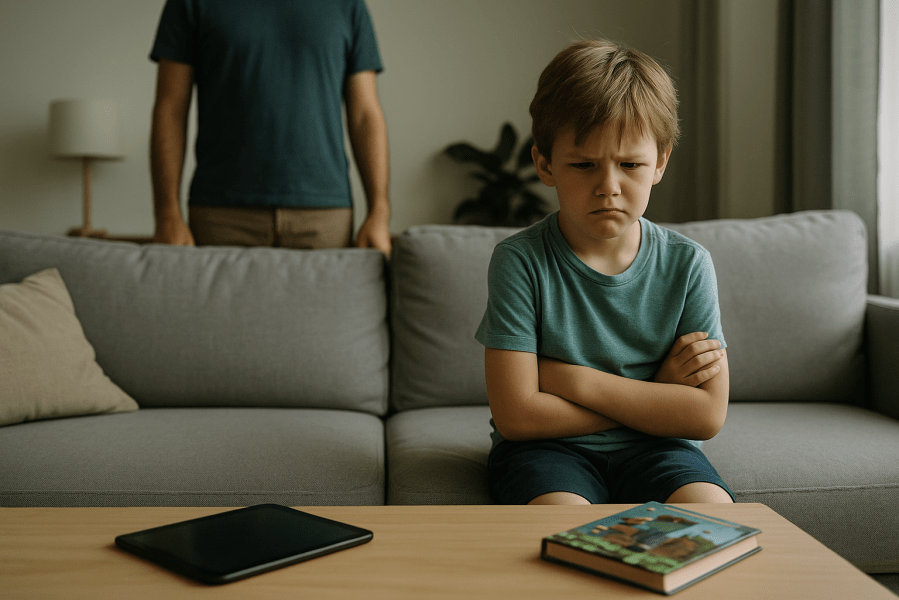
Before breakfast, we played Minecraft for 15 minutes and had fun. We’re playing in survival mode now, building everything from scratch. Then the iPad went off, and we both got ready for the day. After breakfast, I told him it was time to go. He picked up the iPad and started watching YouTube. I took it and reminded him—no more screens today. He shouted that I wasn’t being fair. I took a deep breath and went back to getting ready. I left the iPad on the coffee table, trying to show I trusted him.

But as soon as I left the room, he grabbed it again.

This time, I took it back and said, “You’ve lost the iPad for tomorrow morning too.” Maybe not the best thing to say in that moment, but it came out.

He exploded.

He leapt off the couch, tears in his eyes, and screamed at me:
“Shut the f*ck up! You can’t say that!”
Then he ran into the office to cry. A few moments later, he came back out to yell again. I stood there, trying to stay grounded. My instinct was to react—to yell back, or give a quick swat. But I didn’t.

I breathed. I stood still.

That’s not language he hears from me. I know exactly where he’s heard it. And it hurts, deeply, to see him so angry, and to have that anger pointed at me.

When I finally got him out the door, he wouldn’t look at me or speak. On the drive to camp, I kept thinking about how to reconnect. I didn’t want to lecture. I just wanted him to know I still cared. In Minecraft that morning, he’d said he wanted to mine down to Y-coordinate 13 because that’s where the diamonds are.

So I asked, “Hey, how do you know that’s where the diamonds are?”

He looked surprised that I wasn’t still focused on what had happened. Then he started talking about Minecraft, about strategy, about what he’d learned. It was a lifeline.

When we got to camp, I put a hand on his shoulder and asked,
“Hey, are we good?”
“Yeah,” he said quietly, and walked in with a friend.

It took me a swim and most of the morning to recover. I felt like I’d failed. Like maybe he was growing into an angry, reactive kid with an uncannily precise use of swear words. But at lunch, I reminded myself: being a dad is sometimes thankless. I won’t get it right every time. Neither will he. And that’s okay.

This morning, without the iPad, he seemed more centered. He didn’t say much, but he made eye contact. There was a different energy—like he understood that how he acted yesterday wasn’t okay. Not because he got upset. That part’s fine. It’s even fine that he needed space. But the way he spoke? That’s not how we treat people in our family.

We’ll talk about it more after his track meet today, maybe. Not to rehash it, but to reflect. To grow. To find better ways next time, for both of us.

And I’ve been thinking more broadly, too, about screens. Not just the rules we set, but how easily they can take over. Minecraft, YouTube, and endless downloads—none of them are evil. But they are addictive. For kids especially, screens can become emotional regulation tools, attention vacuums, and reward systems all in one. When you take them away, what’s left is often frustration—and a void they don’t know how to fill.

But if we hold space for that void, if we pace the day without digital noise, what can emerge is powerful. Their minds begin to wander again. Creativity returns. Imagination reawakens. And connection, real, human, face-to-face connection, has room to grow.

We’re still figuring it out. This summer, I’ll need to be more intentional about screen-free days. I’ll plan more trampoline jumps. More wrestling matches. More silly moments. And I’ll keep giving both of us grace.

We’re not just parenting.
We’re learning.

And the truth is, screens aren’t the problem.
They just amplify what’s already there—or missing underneath.

Some days are harder.

But we’re still here.
Still learning.
Still choosing connection.

If this story resonated with you, I’d love to hear your thoughts. How do you handle tough days as a parent? Leave a comment below or share this with another parent who might need it today.