Some days hit harder as a parent. This week, I had one of those days.
It’s the first full week of summer vacation, and my son and I have slightly different visions of what that means. I’ve been trying to keep a balance—structure without being rigid, free time without falling into too much screen time. During the school year, I created no-screen Sundays and Wednesdays to set aside time for connection: bouncing on the trampoline, Beyblade battles, or just being silly together. Some mornings, he’d sneak in early iPad time. I let it slide occasionally, telling myself I was being flexible rather than inconsistent. But I stayed firm on evenings and weekends.
Now it’s summer. More time, more freedom, and more friction.
This morning, we woke up together, and he went right for the iPad. I reminded him it was a no-screen day. He seemed okay with that while I made breakfast and packed lunch for camp. Lately, we’ve had a nightly tradition: 10–15 minutes of Minecraft before bed. But the night before, we didn’t get to it—track practice ran late, I had an extra errand, and bedtime came fast. I apologized to him for my part in getting him off the field later than I’d planned. I knew he was disappointed.
I’ve taught my son to think in terms of win-win solutions. So he suggested we play Minecraft together the next morning before camp. That felt fair, and we agreed.
He’d just come back from a weekend with his mom, visiting cousins in New York and staying up late every night. He was tired, off-rhythm, and emotionally frayed.
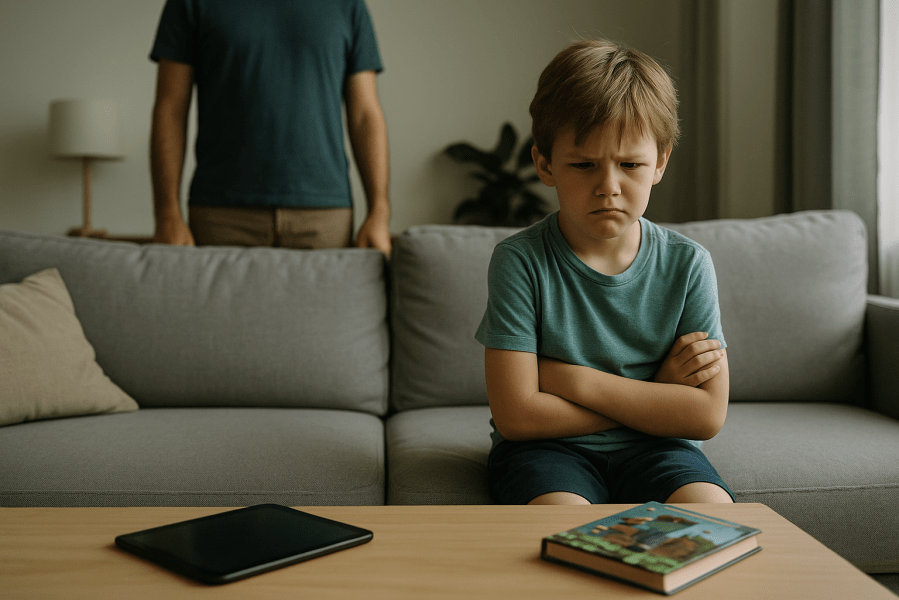
Before breakfast, we played Minecraft for 15 minutes and had fun. We’re playing in survival mode now, building everything from scratch. Then the iPad went off, and we both got ready for the day. After breakfast, I told him it was time to go. He picked up the iPad and started watching YouTube. I took it and reminded him—no more screens today. He shouted that I wasn’t being fair. I took a deep breath and went back to getting ready. I left the iPad on the coffee table, trying to show I trusted him.
But as soon as I left the room, he grabbed it again.
This time, I took it back and said, “You’ve lost the iPad for tomorrow morning too.” Maybe not the best thing to say in that moment, but it came out.
He exploded.
He leapt off the couch, tears in his eyes, and screamed at me:
“Shut the f*ck up! You can’t say that!”
Then he ran into the office to cry. A few moments later, he came back out to yell again. I stood there, trying to stay grounded. My instinct was to react—to yell back, or give a quick swat. But I didn’t.
I breathed. I stood still.
That’s not language he hears from me. I know exactly where he’s heard it. And it hurts, deeply, to see him so angry, and to have that anger pointed at me.
When I finally got him out the door, he wouldn’t look at me or speak. On the drive to camp, I kept thinking about how to reconnect. I didn’t want to lecture. I just wanted him to know I still cared. In Minecraft that morning, he’d said he wanted to mine down to Y-coordinate 13 because that’s where the diamonds are.
So I asked, “Hey, how do you know that’s where the diamonds are?”
He looked surprised that I wasn’t still focused on what had happened. Then he started talking about Minecraft, about strategy, about what he’d learned. It was a lifeline.
When we got to camp, I put a hand on his shoulder and asked,
“Hey, are we good?”
“Yeah,” he said quietly, and walked in with a friend.
It took me a swim and most of the morning to recover. I felt like I’d failed. Like maybe he was growing into an angry, reactive kid with an uncannily precise use of swear words. But at lunch, I reminded myself: being a dad is sometimes thankless. I won’t get it right every time. Neither will he. And that’s okay.
This morning, without the iPad, he seemed more centered. He didn’t say much, but he made eye contact. There was a different energy—like he understood that how he acted yesterday wasn’t okay. Not because he got upset. That part’s fine. It’s even fine that he needed space. But the way he spoke? That’s not how we treat people in our family.
We’ll talk about it more after his track meet today, maybe. Not to rehash it, but to reflect. To grow. To find better ways next time, for both of us.
And I’ve been thinking more broadly, too, about screens. Not just the rules we set, but how easily they can take over. Minecraft, YouTube, and endless downloads—none of them are evil. But they are addictive. For kids especially, screens can become emotional regulation tools, attention vacuums, and reward systems all in one. When you take them away, what’s left is often frustration—and a void they don’t know how to fill.
But if we hold space for that void, if we pace the day without digital noise, what can emerge is powerful. Their minds begin to wander again. Creativity returns. Imagination reawakens. And connection, real, human, face-to-face connection, has room to grow.
We’re still figuring it out. This summer, I’ll need to be more intentional about screen-free days. I’ll plan more trampoline jumps. More wrestling matches. More silly moments. And I’ll keep giving both of us grace.
We’re not just parenting.
We’re learning.
And the truth is, screens aren’t the problem.
They just amplify what’s already there—or missing underneath.
Some days are harder.
But we’re still here.
Still learning.
Still choosing connection.
If this story resonated with you, I’d love to hear your thoughts. How do you handle tough days as a parent? Leave a comment below or share this with another parent who might need it today.


 Mindful Dad Life