The other day, my son stood in front of the mirror, shirtless, hands behind his head, flexing.
He turned sideways, checked his waistline, nodded approvingly, then looked at me and said matter-of-factly and said “I’m always going to have a slender waist.”
I smiled, because, yeah, he gets that flexing part from me. But then he followed it up with,
“Why are some people not in good shape?”
And that’s when I felt it. The moment.
The one where a simple question opens the door to something much bigger.
Curiosity Isn’t Cruel—But It Can Still Hurt
My son is eight, and like many kids his age, he’s starting to notice things.
Bodies. Differences. Who has muscles, who doesn’t. Who moves fast. Who doesn’t.
His mom, for instance, is on the heavier side. He calls her “fluffy” or “soft,” which, in his mind, isn’t an insult—it’s an observation. But the thing is, they’ve had some tension lately.
More than once, he’s asked her why her belly is so big.
And she’s taken it personally, which I understand. Because even though he doesn’t mean it cruelly, it still stings. Words from our kids can cut deeper than we expect.
He Gets the Flexing from Me
Studies show that kids start forming body image beliefs as early as age five. Whether they’re flexing in front of the mirror or repeating something they heard at school, they’re already learning what’s “good” or “bad” about bodies—often from us.
I’m not going to pretend I don’t care about how I look. I lift weights, track my workouts, and yeah, I flex sometimes too.
He sees that. Kids always see.
So when he checks himself out in the mirror or brags about his abs (he’s convinced he has a six-pack, by the way), I recognize that he’s learning pride in his body the same way I once did, by copying someone he looks up to.
That part’s not a problem.
It’s what comes next that matters.
The Dad Lesson: 3 Things I Want Him to Know
1. Health Is More Than Looks
We talked about what it really means to be “in shape.” That it’s not just about looking strong but feeling strong and confident.
“Some people run fast. Some can lift heavy things. Some people take longer to move or heal. That’s all part of being human.”
Bodies change. Bodies age. They carry stories we don’t always see—or even know to ask about.
Other People’s Bodies Deserve Respect
I told him:
“It’s okay to be curious, but asking why someone’s body looks a certain way can make them feel embarrassed or sad. Even if you didn’t mean to hurt their feelings, your words have power.”
We talked about his mom, about how she might feel when he asks about her belly.
And I reminded him that kindness isn’t just about hugs and nice words, it’s also about knowing when not to say something.
It’s Okay to Be Proud; Just Stay Humble
I want him to feel good in his skin. To love the body that helps him climb, swim, run, and wrestle me to the ground in our living room.
But I also want him to understand: muscles don’t make you better than someone else.
“You can be proud of your body, but never use it to make someone feel worse about theirs. Don’t compare yourself to anyone else. Everyone’s body is different—and that difference is what makes us special.”
Bodies Are Personal—And Powerful
Research confirms that kids absorb how we talk about our own bodies. If they hear us complain about our weight or praise looks above all else, they learn to measure worth the same way. A 2020 study in the Journal of Adolescent Health found that parental comments about weight and appearance are directly tied to children’s body image—both positive and negative.
I keep thinking about how young this starts.
How quickly kids begin to measure themselves—and others.
And how easy it is, without meaning to, to pass on our own hang-ups or judgments.
It’s made me more aware of my own mirror time.
Of how I talk about my body in front of him.
Do I joke about getting old? Complain about my belly? Praise myself only when I “look good”?
Because if I do, he’s soaking it in.
What I Hope He Remembers
I hope he remembers that bodies are amazing, even when they’re soft, wrinkled, scarred, or tired. What makes a body “good” isn’t how it looks, but what it lets us do; hugging, laughing, holding hands, resting, and keeping going.
I hope he keeps flexing in the mirror, proud of what he’s building.
But I also hope he looks at others with softness, too.
The Bottom Line
Science backs this up: teaching empathy and body diversity reduces teasing and fat-shaming among kids. A 2019 study in Pediatrics found that children who learned about body differences and practiced empathy were far less likely to stigmatize or bully peers based on weight. This isn’t just about kindness—it’s about protecting mental health for the long haul.
Being a dad means catching these little moments and turning them into something bigger.
Not with a lecture. Not with shame.
But with presence. With love. With the long game in mind.
Because one day, my son’s going to be a man.
And when he looks at someone who’s different than him—bigger, slower, older, softer—I want him to see a whole person.
Not just a body.
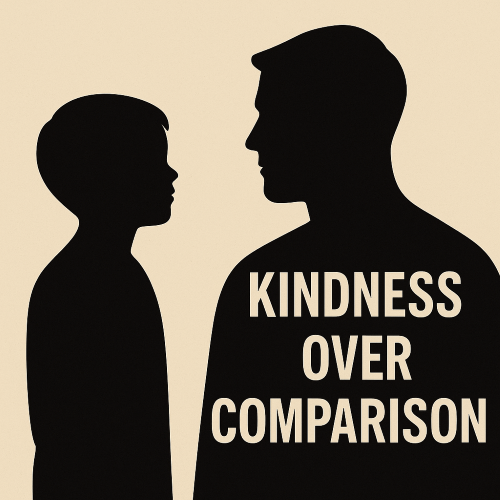
If this story resonated with you, feel free to share it or leave a comment. Let’s help raise a generation that leads with kindness—not comparison.


 Mindful Dad Life