Yes Day Adventure Chart


We didn’t just have fun: We ate of life with golden teeth.

Here is my Yes Day Adventure Chart you can use with your family. It’s the same structure my son and I used, with space for your own rules, budget, and big plans.


Family Name: ______________________
Date: ______________________

Budget: $_________
Item Limit Per Store: __________

Ground Rules

Morning Plans:


Afternoon Plans:


Evening Plans:


Special Yes Requests (Parent & Child):

  • Parent’s Yes #1: ______________________________________
  • Parent’s Yes #2: ______________________________________
  • Child’s Yes Highlights: _______________________________

Memorable Moments:


Favorite Part of the Day: ___________________________
Next Yes Day Date: _________________________________

The Day I Said Yes to Everything (Almost)

Typically, my son knows that Sundays are no-screen days. Last weekend, though, I threw most of the rules out the window and let my son be in charge.
Instead of our usual day together, my son and I played video games, ate rotisserie chicken with our hands, and closed down a theme park.

It was our first-ever Yes Day, and it might just be the best parenting decision I’ve made all year.


What’s a Yes Day?

If you’ve never heard of it, a Yes Day is exactly what it sounds like: for one day, within a few agreed-upon boundaries, your kid is in charge. You say “yes” to their requests.

Some parents I talked to lit up instantly, “Oh, Yes Days, that’s great, I’ve wanted to have one with my child!” while others looked at me like I’d invented a new parenting fad.

The truth is, I didn’t invent it. But after one day of trying it, I can tell you it’s worth every ounce of energy you’ve got.


Setting the Rules

I wanted my son to have real decision-making power, so we sat down and came up with a framework for the day.

We both agreed to:

  • A reasonable budget.
  • A few activity boundaries (nothing unsafe, nothing wildly out of reach).
    • This included no going through a car wash with the windows down!
  • A one-item-per-store limit.

We negotiated the budget like a couple of seasoned diplomats — I offered $100, he countered with $1,000, and we landed on $200.

That, and a shared agreement that the day was about adventure, not just shopping.


The Morning; and Letting Go

We kicked things off by breaking my own rule: no-screen Sunday. We played video games together, and I didn’t rush us. My son clearly had a few ideas in mind, but wanted to “surprise” me with his plans for the day.

Meanwhile, a hot water heater in my greenhouse had sprung a major leak. Normally, I’d have dropped everything to fix it. But this was our Yes Day, and that meant shutting off the water and letting it wait.

That small choice set the tone, my son knew I was all in.


Stop One: Island Toys

His first pick was Island Toys, where he proudly bought a Rubik’s cube I’d told him he couldn’t have for his birthday.
Yes Day: 1, Dad’s birthday gift plan: 0.


The Nerf Gun Debate

Next, he floated the idea of a $100 Nerf gun at Target.
But he also wanted to go to Fun Town Splash Town, and I told him Target would cost us an hour of playtime.

He weighed his options and chose the theme park. Watching him think through the trade-off was satisfying and eye-opening. I watched my son weigh his options and make a sound choice.


Fun Town Splash Town Takeover

My son led the way, from the first ride to the last arcade game. I was just the backup crew, making sure he stayed hydrated and fueled.

We hit the water park after most of the rides, raced from slide to slide, then dove back into the park for more rides, Skee-Ball, and one last round of fun before the gates closed.

The kid was in full mission mode, serious when he needed to be, but grinning ear to ear most of the time.


Dinner by Hand

We aimed for Whole Foods burritos but missed the kitchen cutoff by minutes. So we improvised:

  • One rotisserie chicken
  • A fresh baguette
  • Rosemary ham
  • Teriyaki seaweed
  • Chicken soup
  • Two pastries (one chosen purely for curiosity’s sake)

We sat down and pulled the chicken apart with our hands, laughing like we’d just discovered a new sport. He declared his fruit tart “edible slime,” which only made us laugh harder.


My Two Yeses

Part of the deal was that I got two Yeses, too. My first was for him to approach someone interesting and ask if they had any advice for him.

He didn’t quite work up the nerve, though he scanned the room like he was considering it. I ended up chatting with a couple of women sitting nearby, using it as a moment to model social skills.

My second Yes came at the very end of the day: I asked him to get ready for bed without any fussing or stalling. It didn’t go perfectly; he was tired and still charged from all our adventures, but I could see him trying. And that effort meant more to me than a flawless bedtime routine ever could.


The Grand Finale

We drove to a brand-new obstacle course in Portland and ran the entire thing together. By the time we headed home, we were happily exhausted; the good kind of tired you earn.

At bedtime, Bear curled up and told me, “We had the best day ever together.”


The Reflection

That night, I realized something: there are moments when I say no to him for no real reason — just because it’s easier, or it’s not what I had in mind.

Yes Day reminded me that saying yes to his ideas, his energy, and his quirks can open doors to connection we don’t get any other way.


Why You Should Try It

You don’t need a theme park or a big budget. You just need:

  1. A set of boundaries you both agree on.
  2. A budget that works for you.
  3. The willingness to let your child lead.

What you get in return? Pride in their own decision-making, memories that will stick for life, and the joy of seeing your kid fully, unapologetically be themselves.


We didn’t just have fun — we ate life with golden teeth that day.

If you want to try it yourself, I’ve created a Yes Day Adventure Chart you can download and use with your family. It’s the same structure my son and I used, with space for your own rules, budget, and big plans.

Download the Yes Day Adventure Chart here →

Learn to Hypnotize Your Kids for Fun and Profit(No swinging watches required.)

Ever wish you could skip the bedtime battles or help your kids calm down faster? Here’s your parenting secret weapon: gentle, trust-based hypnosis for kids.

No, it’s not mind control — it’s about creating calm through connection. This approach helps your child feel safe, grounded, and emotionally supported, making it easier for them to relax and follow your guidance.

The fun is in the peace and laughter that comes when everyone’s well-rested.
The profit is the time, energy, and emotional strength you’ll gain, and the confidence your child will carry with them.

✨ Use it to:

  • Help kids fall asleep faster
  • Ease anxiety or big emotions
  • Build focus and self-trust through imagination

Learn how to turn bedtime into bonding time with this mindful, science-backed parenting approach.

Want to try it tonight? I’ve shared a step-by-step guide and sample script on the blog. 👉 Read the full post at Mindful Dad Life — because parenting should feel a little more magical (and a lot more restful).

#MindfulParenting #PositiveParenting #HypnosisForKids #ParentingTips #GentleParenting #SleepTipsForKids #EmotionalIntelligence #ParentingHack #KidsMentalHealth

Learn to Hypnotize Your Kids for Fun and Profit

(What’s the fun part? It’s the fun you’ll both share when you’re well rested and the quiet wonder of seeing your child finally drift off to sleep, knowing you helped create a safe space for them. The profit? Time gained, trust built, and calmer evenings for everyone.)

(A Mindful Parent’s Guide to Creating Calm and Building Connection)

Intro: It was 9:42 p.m. My son was still wide awake, sword-fighting invisible skeletons in his bed, too excited about tomorrow to get to sleep tonight. I was exhausted, teetering on the edge of frustration and defeat. I’d tried reading. Snuggling. Reasoning. Walking away. Nothing worked.

That night, I tried something different. I lowered my voice. Slowed my words and guided him through a story about floating on a cloud. It took a couple of tries for my son to realize that he didn’t need to add to the story, just listen to it and see himself lying on that cloud. By the time we reached the stars, he was asleep.

That moment changed everything.

This post isn’t about stage hypnosis or swinging pocket watches. It’s about a mindful, science-backed way to help your child feel calm, focused, and emotionally connected to you, especially when it matters most.


What Hypnosis Really Is (And Why It Works for Kids) Hypnosis is simply a state of focused attention paired with guided suggestion. It’s what happens when a child gets lost in a daydream, or deeply absorbed in a bedtime story. Their bodies relax. Their minds open. And suddenly, they’re fully present.

Kids are especially receptive because their imaginations are powerful, their minds are flexible, and they respond to tone, rhythm, and imagery more naturally than logic or rules.

Used with trust and care, this approach helps children:

  • Fall asleep faster
  • Calm themselves during emotional moments
  • Boost confidence before stressful events
  • Develop stronger self-awareness and emotional intelligence

Step-by-Step Guide: How to Gently Hypnotize Your Child

1. Set the Stage

  • Choose a quiet, calm space (usually bedtime works best)
  • Reduce noise and light, and make sure they are comfortable
  • Explain it in child-friendly terms: “Let’s play a pretend game to help you feel calm and relaxed.”

2. Use Your Voice

  • Speak slowly, softly, and with long pauses
  • Keep your tone warm and consistent
  • Model breathing: deep in, slow out

3. Guide the Imagination Use visual metaphors your child enjoys:

“You’re floating on a warm, puffy cloud… it starts on the ground, you step onto it and sit down, as it rises up, you relax, lie down and watch, as it’s taking you across the sky, past stars, past the moon… and you’re feeling lighter… and sleepier…”

4. Repeat and Reassure Repetition deepens the relaxed state. Say things like:

“You’re safe… you’re calm… you’re loved…” “With every breath, your body feels more relaxed.”

5. Close Gently End with a calm phrase or cue:

“When I count to three, you’ll drift into sleep, feeling peaceful and proud.” Or simply: “I’m here. It’s okay to rest.”


Sample Script: Bedtime Calm

“Close your eyes and take a deep breath… Imagine you’re holding a balloon, and every time you exhale, the balloon floats a little higher into the sky… Now imagine you’re floating too, light and gentle, up toward the stars… They sparkle just for you…”

(Use your own voice and add your child’s favorite images—clouds, castles, animals, forests, anything that will help them focus and become calm.)


Important Notes

  • Never use this to manipulate or control behavior—it should always be collaborative and safe. The goal isn’t to get your child to do what you want, but to guide them toward a calm, centered state where they can choose rest, focus, or simply feel a sense of inner peace and safety. Hypnosis in parenting should feel like a shared experience, not a tool for compliance. When in doubt, return to connection, trust, and empathy as your guiding lights.
  • Not every child will respond the same way, and that’s okay. Some may want to talk, giggle, or even resist relaxing altogether—and that’s a normal part of learning. If your child wants to chat, let them. Acknowledge their thoughts gently and guide them back with phrases like, “That sounds important. Let’s finish this story first, and we can talk after.” If they stay restless, don’t push. You’re still building trust and introducing a new routine. Over time, your consistency and calm tone will become the invitation they learn to accept.
  • It gets easier with practice and trust. The more you use these calming scripts, the more your child will begin to recognize the rhythm of your voice and the safety it represents. Over time, they may even begin to look forward to it—not just as a way to fall asleep, but as a shared moment of connection and calm. Like any new skill, it grows stronger with gentle repetition, patience, and the quiet belief that even if it doesn’t seem to work at first, you’re planting seeds that will take root.

Final Thoughts The biggest surprise for me wasn’t that it worked—it was how connected I felt to my son afterward. Like we had just quietly built a bridge between his world and mine. Not a trick. Not a hack. Just presence.

And that might be the most powerful parenting tool of all.


Want to try this with your child? Save this post or share it with a fellow parent. And let me know how it goes.

Because the truth is, parenting doesn’t need to be a power struggle. Sometimes, it just needs a softer voice and a little imagination.

Raised by Wolves: The Word I Swore I’d Never Say

By: The Mindful Dad’s Life

My son and I have a new favorite food, burritos from Whole Foods. We had one last weekend after a two-hour rock-climbing session, and it was hands down the best thing either of us had eaten in a long time. It’s become a bit of a ritual now: climb hard, burrito recharge.

Yesterday, after a 6-hour track meet, we stopped in again for a late lunch. We were both pretty hungry. My son ordered first. The woman behind the counter was Russian, I think. She was very polite, patient, and attentive. She listened carefully as he confidently asked for a half-pork, half-steak burrito with rice, sour cream, and hot sauce.

He had watched the burrito-making process closely the last time and thought he knew the routine. So when she placed the wrap in the steamer and turned away to grab something, he got a little impatient. Standing on a nearby display shelf, he said loudly, “Where’s the wrap, stupid?”

Without thinking, I grabbed him firmly by the shoulders and pulled him down.

“That is incredibly disrespectful and rude,” I said, my voice low but sharp. “You do not call someone stupid. You don’t know her, and she’s the one working to make your food. She would probably rather be someplace else, and she’s doing her best. You treat her with kindness and respect.”

He nodded silently, eyes downcast. I let go of his shoulders, and he walked a few steps away. A minute later, he came back and tried to play with me, like nothing had happened.

But something had happened: for both of us.

As we stood there waiting for our food, I found myself replaying the moment again and again. The moment cracked open something old in me, something buried deep but not forgotten. Was that the best way to handle it?

Because the truth is, I flinched when I heard that word. Stupid. That word lived in my house growing up. It lived in my mother’s voice. She called me stupid almost every day until I was 16, when I finally stood up and said, “I’m not stupid. I’m actually really smart.” Her response was to come at me with a broom handle. That day, for the first time, I was strong enough to stop her and walk away, unharmed and strangely proud. Proud that I had finally stood up for myself.

That word *stupid* carries a weight in my life. It was never just a word. It was a label, a weapon. So when I heard it from my son’s mouth, even casually, it hit like a wave. My reaction wasn’t just to his moment, it was to mine, still echoing years later.

And yet, my son is not me. He’s a child, not a threat. He was hungry, tired, and trying to be funny. He was pushing the boundary, not breaking it. And I, the man trying so hard to do this right, reacted from a place of pain instead of presence.

In no way do I ever condone the beating of children as a form of discipline. I was, hopefully, the last generation of children to have been beaten by their parents. I was hit with hands, fists, belts, my own toys, cricket bats, and broom handles. It left a very deep mark on my psyche that took years to heal, years to learn to trust, to love, and to feel safe again in my own body.

So I ask myself now: was it okay to grab him like that?

In that moment, it felt necessary. I wasn’t rough. I didn’t yell. But it was immediate and stern. I wanted to stop the behavior before it grew roots. And for boys, who often learn through movement and energy, sometimes a physical redirection can be helpful, but only when it’s calm, non-threatening, and followed by reflection. (That’s the part I didn’t do.)

Still, I know I could have done better. A touch on the shoulder. A quiet crouch to his level. A firm, respectful tone without needing to startle him. I could have protected the moment without letting my old wounds lead the charge.

That instinct I felt—the flash of heat, the pull to act—that’s the wolf in me. The part that learned, as a boy, that no one was coming to protect me, so I had to learn to protect myself. It kept me safe. It gave me strength. But that wolf, while loyal and fierce, now needs to learn how to be gentle around my son.

My son doesn’t need to be hardened to survive. He needs to be guided to thrive.

We never spoke about it again, but I made sure to thank the woman sincerely when she handed me my burrito. Not just for the food, but to show him how I treat others.

I’m still learning.

Still healing.

Still choosing the father I want to be, every single day.

And to any parent reading this who has ever questioned themselves, I see you. You’re not alone. The journey is hard sometimes, but you’re doing the work, and that matters more than perfection ever could.

Dating Again as a Single Dad: Am I Really Ready?

After divorce, I didn’t rush back into dating. I focused on my son, on healing, and on rebuilding my life with intention. But one quiet evening, walking up to our house after a long day of work, the gym, and track practice, I found myself wondering what it would be like to come home to someone. Not out of loneliness—but out of growth.

This post shares the real questions I had to ask myself before dating again:

  • What does dating look like when you’re raising a child?
  • How do you build connection slowly and with care?
  • Can I hold space for someone new without compromising who I’ve become?

I’m not looking to rush into anything. But I am open to something real. If you’re wondering what it means to date again as a parent, or if you’re rebuilding after separation, I hope this gives you something to hold onto.

Read the full story at Mindfuldadlife.com

#singledad #datingagain #mindfulparenting #emotionalgrowth #startingover #consciousdating #parentingafterdivorce #healingjourney

How Do You Know If You’re Ready to Date Again?

It’s a strange thing, thinking about dating again. I’m not looking for someone because I’m lonely, but because I’ve changed. I’m also not just dating for myself anymore. I’m dating as a father. And that means the stakes are different, the questions are deeper, and the pace is slower… on purpose. Everything I bring to a relationship now has to be rooted in presence, patience, and honesty. Not just for my sake, but for my son’s too.


The Moment You Realize You Might Be Ready

It doesn’t always happen with fanfare. Sometimes it’s just a quiet afternoon, folding laundry or walking through the grocery store, when you catch yourself wondering what it might be like to share these ordinary moments with someone again. For me, it was coming home on a Monday night, after a long day at work, followed by a quick gym workout, then track practice for my son. As I walked up to our house, I thought that it would be nice to be walking into a home now, with someone to greet us, welcome us in, and share our evening with.

I’m not chasing someone to fix my loneliness; I’ve made peace with my own company, and happily like who I am now. But there’s a shift. I want to share my story with someone. Not to be saved. Not to escape. But because growth invites witness, and maybe even partnership.

I’m no longer driven by heartbreak or fear. The old wounds may still ache from time to time, but I’ve stopped bleeding.

I enjoy my own company—but I wonder what it would be like to share my life again. I imagine another adult in the room, not just in the big milestones, but in the quiet in-betweens.

I catch myself daydreaming about connection, not just companionship. I think about emotional safety, real conversation, and mutual curiosity, things that used to feel like luxuries, but now feel foundational to the kind of connection I want to build.


What Being a Parent Changes

Before I had a child, dating was about timing, chemistry, and maybe adventure. Now, it’s about alignment. Whoever I meet doesn’t just enter my life, they step into a world where my child comes first, always.

My time is limited. My energy is sacred. I don’t have the bandwidth to play games or entertain anything half-hearted. Every decision I make filters through the question: Is this person good for both of us?

Any new person has to fit into a life already built around love and responsibility. Not perfectly. Not instantly. But with awareness and respect.

I’m also starting to ask different questions: Can they respect boundaries? Do they understand that some nights are just mac and cheese and bedtime routines? Are they willing to be patient with the pace that parenting sometimes demands?

It’s not about blending families too soon or seeking a co-parent. It’s about making sure that the emotional atmosphere around me is one my child can safely breathe in.


What Readiness Actually Looks Like

Readiness isn’t a feeling. It’s not a sudden surge of confidence or a green light from the universe. It’s a slow, steady shift in how I’m relating to my own story.

I’m willing to be honest about who I am, not just who I want to be. I’m okay saying, “Here are my bruises,” without making someone else responsible for healing them.

I don’t need someone, but I’m open to someone. There’s a difference between hunger and invitation. The first consumes. The second welcomes.

I can hold boundaries and hold space for connection. I know when to say, “This doesn’t work for me,” and when to say, “Let’s figure it out together.”

I’m able to receive interest without immediately making it a future. I let it be what it is, in the moment.


Fears That Still Come Up

Even when you’re ready, fear tags along. And honestly? That’s probably a good thing. Fear is a reminder that this matters. That you’re putting your heart back in motion and leaving it, and yourself vulnerable.

What if I get it wrong again? I might. We all do. The question is whether I learn, whether I listen, and whether I take responsibility. And now, I’m ready to do all that.

What if I hurt someone—or worse, bring the wrong energy into my child’s life? That fear sharpens my discernment. It slows my steps and helps protect my peace and my son’s. I know I can’t eliminate all the risks (that’s part of being human), but I can stay aware. I can catch myself when I’m triggered, own my reactions, and take responsibility. And I can try to recognize when the other person is being triggered by something that isn’t mine to fix but still deserves compassion.

I’m going to start small. Stay honest. And let someone earn my vulnerability.

If you have them, these fears don’t mean you’re not ready. They mean you care.


Why It’s Still Worth It

Because even after loss, love remains possible. And not just romantic love, but shared understanding, growth, laughter, intimacy. Connection reminds us that we’re still here. Still growing. Still worthy of being seen.

Because my child deserves to see what a healthy connection looks like. Not perfection. Just care. Respect. Communication. Kids learn what love is not by what you tell them, but by what you model.

Because growth doesn’t end when a relationship does, and neither does hope. There is no final version of me. My life is constantly in edit mode. But I have a goal now, one I’m still creating. Still reaching for.

I’m still healing. And that healing deserves company, if and when it feels right.


A Promise to Myself (and Anyone I Might Meet)

I won’t rush. Real connection takes time. And it’s worth the wait.

I won’t pretend. I want to be known as I am, not as an idea, not as a fixer-upper, not as a fantasy.

I won’t use anyone to fill a gap that’s mine to heal. My loneliness is my responsibility. My wholeness, too.

And I won’t write about anyone new in my life without their permission—this blog is about me, not them. These words are mine to own. Their stories belong to them.

If someone chooses to walk beside me, I want it to be because we both feel something real, not because we’re afraid to walk alone.

📚 A Mindful Dad’s Life – Table of Contents

✨ Start Here


⚡ Quick Reads & Summaries (PIN Posts)


💙 Fatherhood Stories


🧠 Mindful Parenting Lessons


🧰 Everyday Joy & Activities


🧠 Reflections & Big Picture Parenting


This list will be updated as new posts are added. For now, enjoy browsing the archives and getting to know the heart behind A Mindful Dad’s Life.

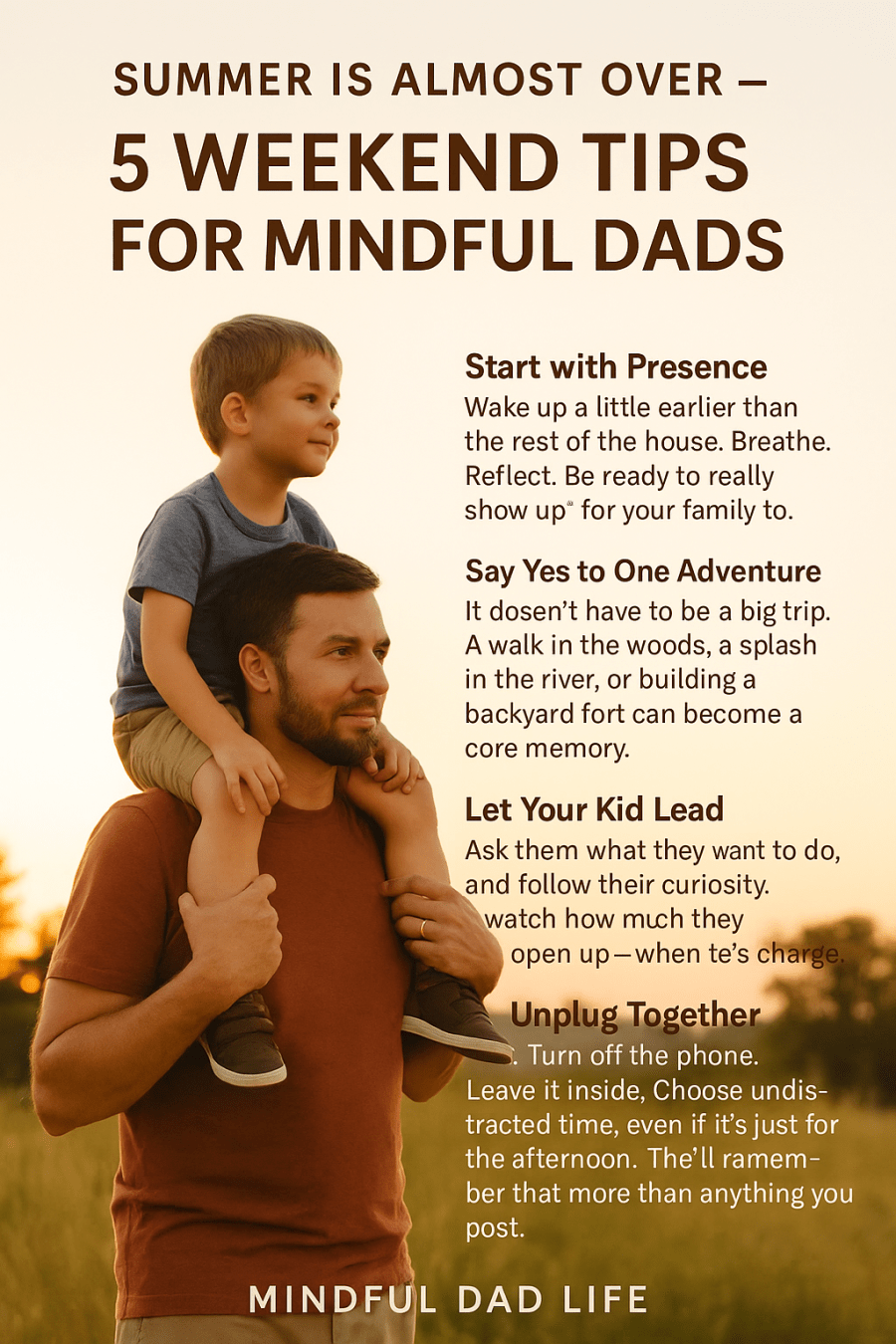
🌅 Summer Is Almost Over – 5 Weekend Tips for Mindful Dads

The days are getting shorter, and back-to-school season is creeping closer. But there’s still time to slow down and savor the weekend with your kids. Here are 5 mindful ways to make it count:

  1. Start with Presence – Wake up a little earlier than the rest of the house. Breathe. Reflect. Be ready to really show up for your family today.
  2. Say Yes to One Adventure – It doesn’t have to be a big trip. A walk in the woods, a splash in the river, or building a backyard fort can become a core memory.
  3. Let Your Kid Lead – Ask them what they want to do, and follow their curiosity. Watch how much they open up when they’re in charge—even just for an hour.
  4. Unplug Together – Turn off the phone. Leave it inside. Choose undistracted time, even if it’s just for the afternoon. They’ll remember that more than anything you post.
  5. End with a Ritual – Share a treat, read a story, or ask them their favorite part of the day. These closing moments build connection and trust over time.

🧭 The goal isn’t to do everything. It’s to do one thing well—with love, patience, and presence.