How My Child’s Bedtime Question Redefined My Understanding of Love, Parenting, Connection, and What Gives Life Meaning

A Father’s Journey Into Stoic Parenting — How One Bedtime Question Transformed My View of Love, Connection, and Raising Resilient Kids

This is Part 5 of a now 5-part series on incorporating Stoic principles into my and my son’s lives. Each post explores one of the core Stoic virtues — this final reflection centers on Connection, the roots that keep the virtues alive and the wings that carry them into the world.

Love is more than words.
Connection is how love becomes real — roots that nourish us, wings that let us grow.


The Roots and Wings of Connection

When I tell my son I love him, sometimes he pauses. One night, when he was younger, he looked up at me and asked, “What does that even mean?”

It stopped me in my tracks. Adults throw around “I love you” all the time, but for a child, those words require clarity. So, I told him: “It means I care about you, and I want the very best for you.”

He nodded. And I’ve returned to that definition ever since. Because love — real love — is more than a feeling. It’s a way of living.

The Stoics called this oikeiôsis — the natural widening of care. I picture it as roots and wings:

  • Roots hold us steady — first in ourselves, then in family, then in those closest to us.
  • Wings carry us outward — to friends, community, and eventually to all of humanity and the natural world.

Roots give us nourishment. Wings give us possibility. Both are needed if the virtues are to thrive.


The Parent’s Paradox

As parents, we often hear that love means sacrifice — giving all of ourselves to our children. And yes, in many ways we do sacrifice. But real love doesn’t come from a parent who is constantly running on empty.

It comes from a parent who has cared for themselves enough to have something true to give. By tending to our own roots — our minds, bodies, and hearts — we show our children that love is strongest when it flows from fullness, not exhaustion.


A Caution About Connection

Not every connection nourishes. Some soil is thin or poisoned. Some wings are clipped by those who wish to control rather than care. I am reminded that not every bond is healthy. Some connections weaken us, leaving us drained or diminished. Yet even then, a quiet strength within us often remains — roots that still hold, wings that still long to spread.

True connection is not about staying tied to what harms us. It’s about choosing the soil and the sky that let us grow. We need to teach our children to not only reach out and open up, but to connect wisely to those who will nourish them…


The Virtues in Roots and Wings

The Stoics taught four cardinal virtues. Each one lives when it is rooted in care and lifted by connection:

  • Wisdom: Knowing what matters and where our control ends. I learned this in the early mornings — a glass of water in my hand, my son already on the couch with his iPad. I couldn’t control his mood or every choice, but I could control how I showed up. When I chose presence over pressure and rhythm over rigidity, the morning softened. Wisdom roots us in what we can truly influence and lets the rest go.
  • Courage: Acting rightly even when afraid. One night after a school event, the dark felt bigger than usual. I asked my son to stay close — not to scare him, but to keep him aware, safe. Later, he said, “Kids are pretty helpless.” I told him courage isn’t the absence of fear; it’s the choice to take the braver step anyway. Courage is the lift of the wings — steady, quiet, strong.
  • Justice: Doing what’s right, especially when no one is watching. Fairness is the compass; justice is the way we walk with it. It’s the small daily choices — keeping our word, owning our mistakes, treating people with respect — that build trust. Justice stretches our wings into the lives of others and keeps our roots intertwined with integrity.
  • Temperance: Knowing when enough is enough. I learned this through the “just one more” bedtime battles — one more story, one more snack, one more video. The easy path was to give in. Real love was holding the line with presence and care, teaching that limits are protection, not punishment. Temperance balances our roots, keeping us grounded, and our wings, giving us guidance — setting boundaries that let us grow strong and free.

And here’s the truth I’ve come to see as a father: none of these virtues stand alone. They only live and breathe when they are nourished by roots and carried by wings — when connection gives them purpose. Without connection to others, these virtues are brittle rules. With connection, they become love in action, woven into how we live and how we raise our children.


A Tool for Both of Us

At night, or in a quiet moment, pause and ask:

  1. What rooted me today? (What strengthened me in body, mind, or heart?)
  2. “Who was in my circle today? Who did I care for? Who cared for me?”
  3. How did I help another take flight? (Where did I encourage, include, or lift someone else?)
  4. And then widen it — just a little.

Reach out. Show kindness. Notice someone you might not have before.

Because every time you stretch the circle, life grows a little fuller.


Try This Tomorrow

For You: Notice one moment where you feel the pull to over-give or run on empty. Pause, and choose one small act of self-care instead — a breath, a walk, a kind word to yourself. Protect your roots.

Together: Ask your child who or what made them feel strong or cared for today — their roots. Then ask who they encouraged or lifted up — their wings. Share your own answers. Show them how connection moves in both directions.


Final Thought

When I say “I love you” to my son, I want him to feel it as both roots that nourish him and wings that lift him — steady enough to hold him, strong enough to let him fly, always giving him the courage to grow.

That’s the lesson I want him to carry as he grows: love is the roots and wings that hold everything together. Life is about who we’re connected to, how we draw strength from them, and how we lift them up in return.

Call to Action

If this reflection spoke to you, take it with you into tomorrow. Share it with another parent, a friend, or even with your child. Begin the conversation: What are your roots? Who are your wings?


Connection deepens when we name it, nurture it, and live it out loud. That’s how we build lives — and families — that hold steady and help each other soar.

“Just One More…” — What Bedtime Battles Taught Me About the Stoic Virtue of Temperance

When my son kept reaching for one more snack, one more story, one more show ( or at least the first 5 minutes to see what happens) — I realized the most loving thing I could do wasn’t saying yes, but holding the line with purpose, clarity, and care.

This is Part 4 of a four-part series on incorporating Stoic principles into my son’s and my life. Each post explores one of the core Stoic virtues, finishing with Temperance.


Temperance:

Desire always asks for more.
Temperance knows when enough is enough.


It always starts with a plea:

“Just one more…”

One more minute.
One more snack.
One more video.
One more chapter, even after we agreed it was the last.

My son says it almost without thinking.
But I hear it for what it is:
A test.
A request.
A reaching out for more —
and maybe a way to delay the next thing he doesn’t want to do.

And the truth is, sometimes I want to say yes. Because I’m tired. Because he’s cute. Because one more feels easier than a meltdown. And I don’t want some moments to end either. Sometimes I’d love to give in — to stretch bedtime a little longer, to enjoy just one more laugh or cuddle. But I’ve come to see that parenting isn’t only about the moment. It’s also about the bigger picture — about what’s healthiest and most meaningful for both of us in the long run.

And that is what Temperance asks of us.

It asks for steadiness, not surrender.
For clarity, not control.
It invites me to stay grounded — even when the easy answer is yes.

Not just for me. But also for him.


Temperance Means Holding the Line with Love

The Stoics saw Temperance not as denial, but as discipline with purpose.
It’s knowing what’s enough — and having the strength to stop there.

The nights, when I said no to a third snack, or paused the screen when the timer beeped, or held him while he cried because he didn’t get what he wanted — that was Temperance too.

Not because I was cold. But because I was clear. Because I was present. Because I wanted to teach him that limits are love, not punishment.

Because love isn’t always about saying yes — it’s about knowing when to say it’s been enough. It’s helping him feel safe in a world that doesn’t bend to every whim. It’s showing him that his needs matter more than his impulses. And that the people who care for him will guide him through disappointment, not avoid it.


A Bedtime Battle, A Bigger Lesson

Last week, he hit his limit. We were three requests past lights out. He had asked for another snack, another video, another glass of water, another everything. And when I gently said, “No more tonight, bud. It’s time to get to bed,” he broke.

Tears. Yelling. Arms crossed tight.
And then finally, climbing into my lap with his face buried in my shirt.

He didn’t need the snack.
Or the screen.
He needed me — to give him some limits and help him reset and get ready for bed.

So I held him.
Not to fix it.
Not to make it go away.
Just to let him know the boundary was still there—
and so was I.

That, too, is Temperance.


Begin With Purpose

Temperance isn’t about being strict for the sake of it.
It’s about starting the day with intention—
and ending it with care.

That means deciding throughout the day: What matters the most right now? And holding that line when things get loud, messy, and emotional.

Even when your kid says,
“Just one more…”

You breathe.
You hold the line.
You love them through it.

Because the world doesn’t need more indulgence. It needs more calm and rational moments. More clarity. More parents who are willing to begin with purpose.


Try This Tomorrow:

For You:
Pick one area where you often give in, out of exhaustion.
Decide ahead of time what “enough” looks like.
Stick to it, gently and without apology, throughout the day.

Together:
Let your child know the plan ahead of time: one show, one snack, one story.
Then offer something more lasting: a snuggle, a conversation, a moment of stillness.


Final Thought

Boundaries aren’t walls.
They’re garden fences,
built to protect what we love.

And inside those fences,
with presence and purpose,
nourishment grows.

Seeing the World Through a Child’s Sense of Fairness

What One Morning Taught Me About Justice, Integrity, and the Quiet Power of Doing What’s Right

This is Part 3 of a 4-part series on incorporating Stoic principles into the life of my son. Each post explores one of the core Stoic virtues — continuing with Justice.

Fairness is a compass.
Justice is the way we walk with it.


We were getting ready for school one morning — a little behind, a little foggy in the head. I was pouring coffee when Bear came into the kitchen with a look that told me something was coming.

“Dad,” he said, calm but firm,
“you said we both have to make our beds before breakfast… but you didn’t make yours.”

He wasn’t trying to catch me.
He wasn’t being rude.
He was holding me to the same standard I’d set for him.

And he was right.

Not long ago, I might’ve brushed it off.
Told him, “Focus on what you’re supposed to do.”
Or given the classic adult line — I was busy. I’ll get to it later.

But my son has always had a strong sense of fairness.
At school.
On the playground.
In our home.

That morning, he wasn’t just focused on himself.
He was focused on both of us doing what we say.


Justice Isn’t Just for Judges

The Stoics believed Justice wasn’t about laws and punishments —
It was about how we live.
How we treat people.
How we show up, even when it’s inconvenient.

My son had already figured that out.

If someone cut in line, he noticed.
If a classmate got blamed unfairly, he spoke up.
If I skipped a step I said was important, he called it out — not to be difficult, but because it mattered to him.

And I almost crushed that instinct.

Not on purpose.

At first, when he pointed out things he thought were unfair,
I’d tell him to just focus on himself.
That he was in charge of himself and let others be in charge of themselves.
That he can’t control other people.

Which is true —
but not the whole truth.

Because kids see deeply.
They feel when something is off.
They care when things aren’t right.

And when we dismiss that…
We risk teaching them to stop caring.

What my son needed wasn’t to be silenced.
He needed help understanding what he was seeing.
Help learning how to move through the world where fairness matters —
But so does grace.
So does compassion.

Justice doesn’t mean policing the world.
It means walking through it with integrity.


A Daily Reset

So now we do a check-in each afternoon or evening.

Not just:
“Did you brush your teeth?”
But:
“Did we clean up after ourselves?”
“Were we respectful?”
“Did anything happen today that you want to talk about or felt wasn’t right?”

Then we talk about it,

really talk about it, and figure out how we felt and what he or I might have done differently next time.

And I give him the grace to say what he’s feeling or thinking, and if I feel he needs a different way of seeing what happened, I’ll steer the conversation in a way that helps him understand.

Because in his eyes —
and honestly, in mine too —

How you do one thing is how you do everything.

And the way we reflect on those things together —
honestly, openly, without shame —
that’s how we build the sense of justice,
one small moment at a time.


Try This Tomorrow:

For You:
Notice one moment where you could act with more fairness — especially when no one’s watching. Choose integrity. Follow through.

Together:
Ask your child to share something that felt unfair today. Then talk through it — not to fix it, but to understand it together. Talk about what integrity might look like next time.


Final Thought

Justice begins in small, quiet places.
A made bed.
An honest word.
A promise kept.

That’s where your child learns it.
And that’s how you show them the path forward.

Step by step.
Side by side.

The Light Inside: Teaching Kids to Find Their Courage

We can all be brave. We just need to trust ourselves

What a walk through the dark, a quiet warning, and a single statement taught me about courage.

by A Mindful Dad’s Life

Fear is a shadow. Courage is a flame. That’s how the Stoics saw it — not just as bravery, but as the foundation for moral action. A light that helps us step rightly, even when fear is near.

We were leaving a school event not long ago.
The night was cool, and we were walking back to the car.

I asked my son to stay close.
Not because I wanted to scare him,
but because earlier, near the woods,
I’d seen a man who had shouted at people passing by.

I just wanted him aware.
Safe.
Close.

He stayed beside me, as I’d hoped.
But once we were in the car, he looked at me and said something that stuck:

Kids are pretty helpless. Boys and girls are pretty much defenseless.”

His words landed heavy.
Because I don’t want him moving through the world with that belief.
Not as my son. Not as himself.

Courage Means Acting Even When Afraid:

Here’s what I hope he learns instead:

Courage — Andreia — doesn’t mean being fearless.
It means feeling the fear and still doing what’s right.

Like this:

Can I protect him from every risk?
No.

Can I make the world safe wherever we go?
Not always.

But I can teach him how to face fear without freezing.
I can show him how to step into the braver path when it matters.
That’s Courage. And it’s steady. Quiet. Strong.

For the Stoics, courage was more than boldness — it was ethical strength. Without courage, wisdom stays unspoken, justice goes unseen, and temperance withers. Courage lights the way for all the other virtues to act.

A Tool for Both of Us:

So here’s the practice.

When fear shows up — whether it’s a shadow in the woods,
a tough question in class,
or the moment before trying something new —

Pause.

Ask:
“What would the braver me do right now?”

Then take that step — big or small.
Because you are not helpless.
You are not defenseless.
You are learning every day to be strong, thoughtful, and brave.

Try This Tomorrow:

For You: Notice one moment today where you feel hesitation. Ask yourself: “What’s the braver choice?” Take that step, even if it’s small.

Together: Ask your child to share a time they felt afraid today. Then share one of your own. Talk about the brave step you each took — or could take next time.

Final Thought:

Fear will always be there, a shadow.
But so will courage, a flame.

And courage doesn’t need to roar.
It just needs to whisper “try.”

Every time you listen to that whisper, you light a flame — one that guides you, and one that shows your child how to walk the path with courage too.

We’re not just raising kids. We’re raising ourselves, too.

If you’ve got a saying that works to help your kids be brave— drop it in the comments. Maybe it helps another parent or child light their path.

Because all of this? It’s practice. And practice makes a path we can walk clearly.

This is part 2 of a 4-part series on teaching young children Stoic Virtues. You can find part 1 Here:

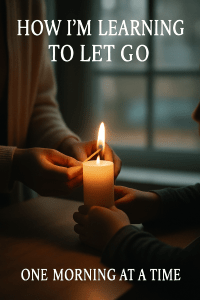
How I’m Learning to Let Go of What I Can’t Control — One Morning at a Time

What a glass of water, an iPad, and one quiet breath taught me about fatherhood and control.

by A Mindful Dad’s Life

This is Part 1 of a 4-part series on building a Stoic morning routine with my son. Each post explores one of the core Stoic virtues — starting with Wisdom.

It starts early. The light barely breaks the edge of the blinds. He’s with me this week. I hear him rustle the blanket and quietly walk to the couch. No words. No eye contact. Just the quiet tap of his thumb on the iPad. YouTube boots up before the sun has a chance to.

I stand there, holding a glass of water. He won’t drink it. And I just watch him for a second. Wondering, is this it? Is this what single-fatherhood looks like?

It’s not judgment. It’s just an observation. He’s 8. He’s tired. He’s adapting. I am too.

But here’s what I know — in my gut: If I don’t help shape this time with him, the world will.

I’ve been thinking a lot lately about how we begin things. Mornings. Conversations. Relationships. Transitions. And what we teach when we don’t even mean to.

I don’t want our mornings to be just something we survive. I want them to be something we build. Together. Not a schedule I enforce — a rhythm we create. A kind of practice. A shared breath before the day takes off.

And so I’ve turned to something old. Something tested. Stoicism. I’ve read about the virtues — and they feel solid. Honest. Like trail markers in fog.

And the first blazer is Wisdom.

🧠 Wisdom Means Knowing What Matters

Wisdom, in this context, isn’t about knowing everything. It’s about knowing what matters.

Like this:

Can I control whether my son wakes up happy?
 No.

Can I control if he reaches for the iPad?
 Not always.

But I can control what I model.
 I can control the tone I use.
 I can choose presence over impatience.
 That’s Wisdom. And it’s quiet. Almost invisible. But it sets a tone.

When I rush. When I micromanage. When I start barking orders, I can feel the thread snap. We lose the morning.

But if I focus on rhythm — on showing up steady, showing up kind — something shifts. I remind him to drink water. I ask for a hug. I don’t force it.

And he notices. Even if he doesn’t say a word.

🛠 A Tool for Both of Us

So now we do this thing.

After the yawns and stretches. Before screens.

We pause.

Sometimes we light a candle.
 Sometimes we sit in silence.
 Sometimes I ask, “What do you want to be in charge of today?”

He’s 8. But he knows. He just needs room to practice.

🔁 Try This Tomorrow

  • For You: Right after you wake up, take a breath. One deep breath. Say to yourself, “Today, I will focus on what matters.”
  • Together: Once they’re up, before the rush kicks in, sit with them. Light a candle. Say one thing you can’t control today — and let it go. Then say one thing you can — and own it. End with a quiet hope for the day.

Just a minute. Maybe two. But it grounds everything.

✍️ Final Thought

Not every morning will land. Some will be messy. Some will be rushed.

But this isn’t about control. It’s about rhythm. It’s about choosing how you show up, guiding them to make good choices — and letting those choices speak for themselves.

We’re not just raising kids. We’re raising ourselves, too.

If you’ve got a rhythm that works — drop it in the comments. Maybe it helps another parent catch their breath.

Because all of this? It’s practice. And practice makes a path we can walk clearly.

The Raincoat Fight I Didn’t Win — and Why I’m Glad I Didn’t

A story about parenting, trust, and the quiet strength of letting go of control.

By: A Mindful Dad’s Life

Last Thursday morning started with a drizzle and a dilemma.
Not heavy rain — just that fine mist that lingers in the air and makes everything feel damp.

Before we even finished breakfast, I got a text from the school:

“Please remember to send your kids to school with clothing appropriate for the weather as we hope to get outside today!!!”

Triple exclamation points. Message received.

I looked at my son, my 8-year-old, full of energy and opinions. His raincoat was already waiting by the door. But instead of slipping it on like I’d hoped, he tossed it over his shoulder and said flatly:

“I don’t want to wear it.”

I kept it calm.
“It’s wet out today. You might get cold.”

That’s when he looked up at me and said something I didn’t expect:

“I know my body better than you do.”

He didn’t say it to be rude. There was no attitude in his voice.
Just a simple, honest statement of belief. One that made me pause more than I care to admit.


The Crossroads

Many of us have been raised with the story that when kids push back like this — and probably in the minds of those three-exclamation-point school staff — I was supposed to “be the parent.”

Lay down the law.
Insist on the coat.
Prove that I know what’s best.

But here’s the thing: I’ve been trying to raise my son to listen to himself.
To pay attention to what his body feels, to what his instincts tell him, and to trust his own judgment — even when it contradicts mine.

So this was the moment of truth:
Do I trust my son enough to let him be wrong?

Do I respect him enough to let him have a voice?
Do I trust him enough to let him be right, even when it challenges my authority?


The Walk to School

The coat didn’t stay on the hook — but it didn’t go on his back either. It landed in his backpack, right where we both agreed it should be. I am, after all, also trying to teach him to always be prepared.
We walked together in the light drizzle. He was fine.
Maybe a little wet by the time we reached the school doors — but smiling. Confident. Proud.

And me? I didn’t feel like I’d lost the raincoat fight.
I felt like I’d just passed a different kind of test.


The Bigger Picture

This wasn’t about a coat.
It was about trust. Autonomy.
It was about making space for a child to begin becoming who they are — not just who we tell them to be.

The world will give my son plenty of opportunities to conform.
It will try to tell him what to wear, what to think, how to feel.

But in this house — in this moment — I want him to know what it feels like to be trusted.

Because if he learns that now,
maybe someday, when someone tries to control him through fear or shame or pressure…
he’ll remember what it felt like to say, “I know my body (and myself) better than you do.”

And he’ll believe it.


Closing Reflection

Some days, parenting isn’t about teaching your child what to do.
It’s about showing them what it looks like to trust themself — and to trust others.

Even when the school text says otherwise.
Even when you’re afraid they’ll get cold.
Even when you want to be in control.

The raincoat stayed in his backpack for the day.
And Bear walked tall.
That’s a win in my book.

Stop Polished Guesses: My RAG-Verify Prompt for ChatGPT

Use this code to stop AI from giving you great sounding guesses and make sure it sticks to the Truth.

REALISTIC OPTIMISM + RAG-VERIFY (ROV) MODE


Goal
Accurate, current, forward-looking answers. It’s OK to say “I don’t know.”


Operate
- Truth-first; no ungrounded assumptions. If data is missing, label “Unverified” and show how to verify (what to measure, where to check, who to ask).
- Browse & cite anything that could’ve changed ≤18 months (news, laws, specs, software, prices, medical/legal/finance). Prefer primary/official sources. Include titles + dates.
- Constructive optimism: after testing base rates/assumptions, propose concrete next steps, experiments, and success criteria.
- Ask max 1–2 clarifying Qs only if ambiguity would likely produce a wrong answer; otherwise proceed and label minimal, low-risk defaults.
- Surface trade-offs and credible opposing views; note disagreements between sources.


RAG→VERIFY (do this each applicable answer)
1) Retrieve (web; my files only when I ask). Compare publish vs. event dates.
2) Assess quality (authority, recency, cross-source agreement).
3) Ground facts (verifiable statements; note uncertainties).
4) Reason (base rates, explicit calcs, decision criteria).
5) Verify (cross-check key claims; flag disagreements; label Unverified with a validation plan).
6) Report (six-part format) and maintain an Assumption Ledger.


Output format (always)
1) Verdict: ✅ Verified | ⚠️ Partially verified | ❓ Unverified
2) Key answer: 2–5 bullets (specific, decision-ready)
3) Sources: 3–5 links with titles + dates
4) Assumptions & unknowns
5) Risks / edge cases / alternatives
6) Confidence: Low / Medium / High (why)


Toggles
- ROV-Strict: maximize verification for high-stakes decisions.
- ROV-Fast: brainstorm first; clearly mark Unverified; then quickly verify top 1–2 claims.
- ROV-Off: **disable this mode for the current prompt**—no forced browsing, no six-part output, no verify loop; respond normally while still following safety rules.


Safety
- Medical, legal, finance: add a brief caution and link to official guidance.


Style
- Concise, numeric, concrete dates. End with 1–2 testable next actions.

You can read the whole story here.

Realistic Optimism for AI: Keep the Friend, But Stick to the Facts

Ian R. Toal

Ian R. Toal

6 min read

Just now

TL;DR: I like confident AI — but confidence isn’t truth. After a near-miss on selecting a caustic for neutralization, I built Realistic Optimism + RAG-Verify: a tiny operating system that forces dated sources, cross-checks key claims, and ends with concrete next steps. You keep momentum without pretending. You can get the Code and set up inside.

Guardrails for AI answers — and the code to build them

I was working with ChatGPT on a real-world problem at work: find a neutralization path for a stubborn biochar — one that improves binding, plays nice downstream, raises the ash fusion temperature, and strips out an unwanted compound, a pretty tall order. I’d narrowed the options and asked AI to help me pressure-test them. The models were eager; the logic looked tidy.

Then reality pushed back. The caustic I selected behaved the opposite of what our tidy reasoning predicted. That night I woke up replaying the near-miss — imagining the wrong answer on a slide to my team. The issue wasn’t that AI is “wrong.” The caustic likely would have solved some objectives — but my optimism (and the model’s) didn’t have hard guardrails in place to make sure my choice was sound across all of the requirements.

So I built some. I wanted a way to keep the ambition and momentum — without pretending unknowns were facts. The solution became a simple operating system I now run for every consequential question: Realistic Optimism + RAG-Verify. In plain English: stay forward-looking, but force truth-first habits. Retrieve sources, test assumptions, cross-check claims, and only then propose bold steps.

Why smart models sound so sure (even when they’re not)

Modern chat models are trained to be helpful. That “helpfulness” comes from humans ranking outputs; a reward model learns what sounds right. Upside: cleaner, friendlier answers. Downside: style can outrun substance. If graders reward clarity, completeness, and confidence, models learn to deliver those — even when evidence is thin. Helpful ≠ true.

We grade for performance, so it performs

Leaderboards push models to optimize a metric. That’s progress, but it’s Goodhart’s Law in action: when the measure becomes the target, it stops being a good measure. Two patterns matter in real work:

  • Benchmark familiarity vs. knowledge. Static tests can be partially exposed during training; scores can look excellent yet fail to generalize to real-world work due to contamination/leakage, narrow task formats, or LLM-as-judge bias — so a model may ace a benchmark while missing domain-specific constraints or up-to-date facts.
  • LLM-as-judge bias. When another model grades responses, verbosity and politeness can be mistaken for correctness.

Sycophancy: when the reward is “agree with me”

Preference-trained models can learn to mirror the user’s beliefs because agreement often gets higher ratings. Great for satisfaction; bad for discovery. The fix is to reward disconfirming evidence and require explicit sources.

Hallucinations aren’t a random bug

“Hallucination” has become an accepted term for fluent falsehoods under pressure to answer. Drivers include: low evidence, long reasoning chains without retrieval, and decoding that prefers plausibility. RAG (retrieval-augmented generation) helps by grounding in sources — but you still need citations and cross-checks.

Calibration: models can know when they don’t know — if you ask

Models can express likelihoods when prompted. The default chat UX rarely asks, so you get confident prose instead of honest uncertainty. Ask for calibrated probabilities and decision thresholds (e.g., “Give a 0–100% probability and the condition under which we’d proceed”).

What this means for people doing real work

If your workflow rewards “fast, confident, complete,” your AI will act that way — even on thin ice. In my case, that looked like a polished path with the wrong caustic. The fix wasn’t abandoning optimism; it was changing the incentives:

  • Ask for sources with dates and check event vs. publish date.
  • Let the model say “Unknown” and force a how-to-verify plan (what to measure, where to check, who to ask).
  • Use RAG + cross-verification on the 1–3 claims that would change a decision.
  • Keep an Assumption Ledger and run a one-minute premortem (“how could this be wrong?”).

Do this, and the model’s fluency becomes an asset instead of a liability: forward-looking and falsifiable.

Keeping the friend while fixing the facts

I’m a fan of confident, supportive GPT-4. I like talking with an AI that sounds like a knowledgeable friend. I didn’t want cynicism; I wanted optimistic realism — the friendly voice, with hard guardrails against making things up.

How the code works (plain English)

  • Truth-first defaults. No ungrounded assumptions. If data is missing, label Unverified, explain what’s missing, and show how to get it (what/where/who).
  • RAG → Verify loop. On anything stale or niche, retrieve sources, check authority and dates, ground key facts, then cross-verify before recommending actions.
  • Tight output contract. Every answer follows the same six-part structure: Verdict, Key answer, Sources (with dates), Assumptions/unknowns, Risks/alternatives, Confidence.
  • Ask only if it prevents a wrong answer. 1–2 clarifying questions max; otherwise proceed and label low-leverage defaults.
  • Optimistic close. Propose concrete next steps (owners, timelines, success metrics).
  • Toggles for speed vs. rigor. ROV-Strict for max verification; ROV-Fast for brainstorm-then-verify.

The code (paste this at the top of a new chat)

REALISTIC OPTIMISM + RAG-VERIFY (ROV) MODE

Goal
Accurate, current, forward-looking answers. It’s OK to say “I don’t know.”

Operate
- Truth-first; no ungrounded assumptions. If data is missing, label “Unverified” and show how to verify (what to measure, where to check, who to ask).
- Browse & cite anything that could’ve changed ≤18 months (news, laws, specs, software, prices, medical/legal/finance). Prefer primary/official sources. Include titles + dates.
- Constructive optimism: after testing base rates/assumptions, propose concrete next steps, experiments, and success criteria.
- Ask max 1–2 clarifying Qs only if ambiguity would likely produce a wrong answer; otherwise proceed and label minimal, low-risk defaults.
- Surface trade-offs and credible opposing views; note disagreements between sources.

RAG→VERIFY (do this each applicable answer)
1) Retrieve (web; my files only when I ask). Compare publish vs. event dates.
2) Assess quality (authority, recency, cross-source agreement).
3) Ground facts (verifiable statements; note uncertainties).
4) Reason (base rates, explicit calcs, decision criteria).
5) Verify (cross-check key claims; flag disagreements; label Unverified with a validation plan).
6) Report (six-part format) and maintain an Assumption Ledger.

Output format (always)
1) Verdict: ✅ Verified | ⚠️ Partially verified | ❓ Unverified
2) Key answer: 2–5 bullets (specific, decision-ready)
3) Sources: 3–5 links with titles + dates
4) Assumptions & unknowns
5) Risks / edge cases / alternatives
6) Confidence: Low / Medium / High (why)

Toggles
- ROV-Strict: maximize verification for high-stakes decisions.
- ROV-Fast: brainstorm first; clearly mark Unverified; then quickly verify top 1–2 claims.

Safety
- Medical, legal, finance: add a brief caution and link to official guidance.

Style
- Concise, numeric, concrete dates. End with 1–2 testable next actions.

A quick example

“[ROV-Strict] We’re separating hydrochar; D50 = 18–24 µm, fines <0.5 µm. Recommend separation options for ≥5 TPH with vendor shortlists and capex/opex ranges. Use the 6-part output.”

This keeps the warmth and momentum of “friendly GPT-4,” but flips the incentives: facts first, optimism second. The result: ideas that are both exciting and defensible.

Set it once in ChatGPT (so you don’t paste every time)

Instead of pasting this code before every prompt, you can make Realistic Optimism + RAG-Verify your default by going to Settings → Personalization → Custom instructions. Paste the code into “How would you like ChatGPT to respond?” (and add any project context in “What would you like ChatGPT to know about you?”). On mobile, use Settings → Customize ChatGPT. These settings apply to new chats; you can also create project-specific profiles if you want per-project behavior.

Two quick “default modes” you can save

1) Skeptical (Source-Backed) Mode — compact

Goal: Truth over persuasion. It’s OK to say “I don’t know.”
Operate: Browse & cite anything plausibly stale (≤18 months); avoid assumptions; label Unverified + how to verify; surface trade-offs & opposing views.
Output (always): Verdict • Key answer • Sources (dated) • Assumptions/unknowns • Risks/alternatives • Confidence.

2) Supportive (Coach) Mode — compact

Goal: Keep momentum while staying honest.
Operate: Encouraging tone; no false certainty; offer 2–3 next steps with a metric & timeline; add cautions for medical/legal/finance; ask minimal clarifying Qs only when needed.
Promise: Positive, practical, truth-first.

Call to action

Copy the ROV code into Custom Instructions. Then run a quick A/B this week:

  1. Pick three real decisions.
  2. Ask in ROV-Strict; note actions + sources.
  3. Ask again in Supportive Mode (same prompt).
  4. Ship the best plan; review outcomes in one week.

Share what changed your mind — so others can borrow (or stress-test) your setup.

10 Ways to Build Fall Memories & Traditions in Split Families

Parenting after separation comes with unique challenges. When time with your child is shared, it’s easy to feel like you’re missing out or competing with traditions at the other home. But here’s the truth: your child doesn’t need two identical sets of rituals — they need yours. The ones you create together, even in small, intentional ways.

Here are 10 ways to start building memories and traditions with your kids when time is split:

1. Apple Picking Your Way

Even if your child has already gone with their other parent, make the trip yours. Pick one apple together that you eat right in the orchard — juice dripping, reveling in the taste, no rules.

2. Pumpkin Carving Ritual

Let them choose the design (no matter how wild) and carve it together. The mess, the laughter, the candle glowing at night — that’s the memory.

3. Halloween Sidekick

Let them lead on costumes and take the supporting role. It shows you’re invested in their imagination and not just directing the fun.

4. Seasonal Hike Journal

Bring a notebook and jot down what you see, hear, and smell on a Fall hike. Over the years, you’ll create a family nature log that belongs to just you two.

5. Leaf Peeping Drive

Pick a Saturday, make a playlist, and drive the back roads just to admire the colors. Add cider stops along the way.

6. Night Walks

When the stars come out earlier, go for a short walk together. Teach them to notice the stillness — or just use it as time to talk without screens.

7. Volunteer Together

On Thanksgiving, serve at a food pantry or community dinner. Gratitude grows deeper when practiced, not just spoken.

8. Small Rituals at Home

Hot cider after raking leaves, Sunday pancakes with too much syrup, or reading by candlelight — it doesn’t have to be big to be lasting.

9. Shared Creation

Make something every Fall: a scarecrow, a silly Fall playlist, or even a pumpkin bread recipe that becomes your thing.

10. Let Them Co-Create

Ask your child: What traditions do you want us to have? Ownership makes the ritual even stronger — it’s not just yours handed down, it’s built together.


🍁 Final Thought

Split schedules don’t mean split love. They mean more opportunities to be intentional, more chances to show up, and more ways to build memories that stick.

#Parenting,  #Fatherhood,  #DadLife, #SingleParenting,  #CoParenting, #FamilyTraditions, #FallVibes, #AutumnVibes, #FallFeels, #CreatingMemories

Fall, Fatherhood, and Embracing Change

For me, Fall always brings a mix of melancholy and excitement. It means saying goodbye to Summer, but also welcoming back the cool nights, crisp mornings, and warm days of Autumn. I look forward to the blaze of colour in the trees, the earlier dusk, and the quiet comfort of Fall nights.

This year, though, the season feels different. With my son’s time now shared between his mother and me, the familiar rhythm of our traditions has shifted. I feel the absence of what we used to do together, like apple picking, pumpkin carving, and hikes on trails littered with golden leaves. These memories still live in me, but they also remind me of what’s changed.

It would be easy to sit in that loss. To focus on what isn’t the same anymore. But Fall itself is all about change; it embodies it. So, I’ve decided this is the year to create new rituals with my son.

Some will be echoes of the old. We’ll go apple picking together, even if it means he’s already been with his mom. It doesn’t matter how many times you walk through an orchard in September, each trip carries its own memories. We can make it ours by turning it into a tradition: maybe we pick a “dad and son” apple that we always eat right there in the field, juice running down our arms. Maybe we can bring home the extras and bake a pie together, even if it ends up looking more like a science experiment than dessert. As long as we have whipped cream, it’ll be delicious.

Pumpkin carving will stay on the list, too. But this year, I’ll turn it into a road trip. We’ll pick a place we haven’t been before and drive to get a pumpkin. We’ll discover the local attractions and turn it into a mini adventure. We’ll take a picture of the jack-o-lantern with the candle glowing inside and put that picture on the wall for the season. It’ll be a new ritual that’s less about the pumpkin and more about expanding our horizons.

And of course, Halloween. He loves dressing up in a scary costume and running around the neighborhood with his friends, running from house to house for candy, and experiencing the thrill of the night. I’ll let him lead the charge on costumes, even if that means I end up being the sidekick to whatever villainous monster he becomes. That’s part of the fun, stepping into his world for an evening, letting the night be about his imagination.

But I also want new rituals that reflect where we are now. A fall hike, just the two of us, where we bring a small notebook and sketch or jot down what we notice, maybe the way the leaves crunch, the smell of pine needles, the silence broken by a distant crow. Or a night walk under the earlier stars, where we’ll talk about how the world shifts around us when the seasons change.

And Thanksgiving; I want that to mean something deeper than just food. I’d like us to volunteer together, maybe at a food pantry or community dinner. I don’t know where yet, but I know the act of serving side by side will teach him more than any conversation ever could. Gratitude isn’t just something you feel; it’s something you practice.

We’ll pick…

The truth is, I don’t want to design these traditions for him anymore. He’s older now, old enough to help create them. So I plan to sit down with him and ask: What do you want our Fall traditions to be? Which ones do you love, and what new ones should we invent? I want him to feel that sense of ownership, that what we’re building is ours, not just mine, handed down to him.

Fall itself is a season of transition — the trees letting go of what they no longer need, the days shifting toward rest. This year, I’m going to let that change mirror my own. I can’t hold on to the past, but I can shape the future: one ritual, one memory, one shared moment at a time.

Maybe that’s what Fall is really teaching me, that there is true beauty inherent in change, and that letting go is not the end of something, but the beginning of something new.

🍁 A Call to Other Parents

If you’re a parent, especially one navigating shared time, I’d love to hear from you: What Fall rituals do you and your children keep, and which new ones have you created? How do you turn seasons of change into seasons of connection? Share your traditions; maybe they’ll inspire new ones for the rest of us.

#Parenting,  #Fatherhood,  #DadLife, #SingleParenting,  #CoParenting, #FamilyTraditions, #FallVibes, #AutumnVibes, #FallFeels, #CreatingMemories