By The Mindful Dad Life.
This story is part 2 of a series of posts that need to be written, both for my own reflections and to help me understand what kind of dad I want to be.
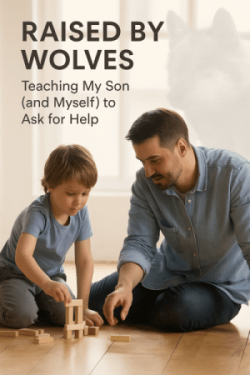
I started noticing it when my son was about four or five. He’d be sitting on the floor with his blocks, or drawing something he’d never tried before, and I could see him struggling—jaw tight, shoulders stiff, refusing to look my way. He wouldn’t ask for help.
And I recognized it instantly, because I was looking at myself.
I’ve spent most of my life with that same instinct, the one that whispers, figure it out yourself, don’t bother anyone, don’t show weakness. I never taught him that, not intentionally, but kids don’t just learn what we say; they pick up who we are. In a lot of ways, we pass on survival habits without even meaning to. Raised by wolves, indeed.
It took weeks “Weeks” of patient conversations to help him get comfortable asking. I’d sit beside him and say, “What can you figure out, and what can I help you with?” or “If you need help, remember, I’m right here.” At first, he’d shake his head and try harder on his own. But slowly, he started asking. Just once in a while at first, then with a little more ease.
And every time he asked, it felt like a small victory, not just for him, but for both of us.
Because if I’m being honest, I’m still learning this myself.
The Freeze
Not long ago, a friend of mine—someone I’d just helped with his art business plan and a new logo he’d been wanting for years—looked me straight in the eye and said, “Anything you need, man, just ask.”
I froze.
My mind went completely blank. Not because I didn’t need help, but because my brain didn’t know how to process that offer. I didn’t know what to say. And that’s when it hit me: this isn’t just habit, it’s wiring.
Why Men Struggle to Ask for Help
Science backs that up. Studies have shown that men are less likely than women to seek help, not just emotionally but practically, whether it’s asking for directions, reaching out for mental health support, or delegating tasks.
Some of this comes from how boys are socialized. Research published in Psychology of Men & Masculinities found that from a young age, boys are more likely to be praised for independence and problem-solving, while girls are encouraged to seek and offer help. By the time we’re adults, those patterns are deeply ingrained.
There’s also biology at play. A 2019 review in Frontiers in Behavioral Neuroscience discussed how testosterone and stress responses interact, often making men more likely to respond to challenges with a “fight-or-flight” reaction rather than a “tend-and-befriend” one, a pattern more common in women. In other words, when something’s hard, our instinct isn’t to ask for help; it’s to grit our teeth and push harder.
That instinct kept our ancestors alive. But for fathers, for men trying to raise kids in a healthier, more connected world, it can hold us back.
The New Pack
I don’t want to raise my son to be a lone wolf. I want him to know that asking for help isn’t weakness, it’s trust. It’s connection. It’s how we build stronger families, stronger friendships, stronger lives.
The truth is, we’re not meant to do it all alone. Wolves survive in packs for a reason.
So I’m trying to rewrite this for myself as much as for him. I’m practicing saying yes when someone offers to help, even if it feels awkward. I’m practicing asking for help before things reach the breaking point. And every time my son looks up and says, “Dad, can you help me with this?” I remind myself: this is what breaking the cycle looks like.
If I can teach him that strength isn’t just doing everything alone, then maybe that’s the legacy that matters most.
For Dads Reading This
If you’re like me, you probably freeze up too. Maybe you think you need to handle everything, to be the strong one all the time. But the strongest thing you can teach your kids is that strength also looks like leaning on people you trust.
Start small. Accept help when it’s offered. Ask for help in one thing this week, even if it feels uncomfortable. Show your kids that trust is strength.
Because we weren’t meant to do this alone. And neither are they.
 Mindful Dad Life
Pingback: 📚 A Mindful Dad’s Life – Table of Contents – Mindful Dad Life